Step inside The Second House, India's first AI restaurant in Goa
This 108-year-old bungalow-turned AI-designed restaurant proves the future of dining can still feel deeply human.
Apr 24, 2026
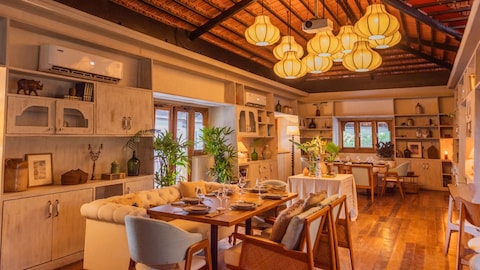
There’s a chandelier inside The Second House in Saligao that took two months to build. Not because it’s enormous, though it is, but because nobody knew exactly what it would look like until it was done. There were no blueprints, no fixed measurements. Just a vision, a prompt, and over 300 iterations of AI-generated imagery before a team of artisans began bringing it to life by hand. The result hangs overhead like something dreamed up in a fever, lush with trailing greenery, sculptural, a little otherworldly. It is, in the truest sense, a collaboration between imagination and machine.
This is what makes The Second House so radical.
“AI” has become a buzzword today, something people are afraid to use, and yet here is a 9,000-square-foot restaurant inside a 108-year-old Goan bungalow that simply got on with it. The project used artificial intelligence not as a gimmick, but as a design partner. Every curve in the corridors, every chair silhouette, every countertop was conceived through iterative digital prompts. And yet, when you walk in, technology is the last thing you’re thinking about.
Instead, you’re thinking about how good it smells. About the warm cement floors underfoot. About whether to sit inside the plush, earthy main house or under the weatherproofed glasshouse, where afternoon light falls naturally.
The project began, as many good Goa stories do, with a conversation and a very old house. Dishant Pritamani, founder of Luna Hospitality, the Mumbai-born group behind beloved spots like The Daily Bar & Kitchen and Tsuki in Pune, spent three months tracking down the original owners of the Saligao villa before a single design decision was made. He wanted to understand its story first. That instinct, to listen before building, runs through everything The Second House has become.
Pritamani brought in architect Ayaz Basrai of Busride Design Studio, known for spaces that reward the curious. Basrai didn’t just want to design a restaurant; he wanted to test something. What if AI tools, which he had long been exploring academically, were the primary design instrument? What if nothing was sourced from a catalogue, and every element had to be conceived, prompted, iterated, and then hand-crafted into existence?
The two-year experiment that followed is the space you walk into today. The result is that rare thing: a restaurant that feels completely original, where you couldn’t point to a reference and say, “I’ve seen this before,” because you genuinely haven’t.
The food, helmed by Chef Jyoti Singh, holds its own against all of this atmosphere, which, given the visual drama of the place, is no small feat. Singh’s cooking is shaped by a career that has taken him from Goa to Kolkata, Cairo to Jakarta, Bali to Mumbai and back again, and his menu at The Second House reads like a quietly confident greatest hits of that journey.
The approach is simple: serve what people know, but give it a twist they can't quite name. The house bread is the best example of this. Part Goan poee, part Egyptian baladi, it arrives warm and a little chewy, the perfect base for the eggplant hummus or the not so balcao, the chef's riff on a Goan classic, threaded with Indonesian spice. It's familiar and foreign at once, which is exactly the feeling The Second House seems to traffic in.
The menu is built for sharing. The pork and rice bowl is the kind of thing you’d come back for specifically. Don’t overlook the salmon toast—ponzu-wasabi, brown butter brioche, a layer of egg yolk jam, which sounds like a lot and somehow lands as exactly enough. The togarashi beef tart and the fresh seabass ceviche with raw mango and poppy seeds are the kind of small plates that are bold but never showy. And if you think you’re not ordering the DIY kimchi cutlet, you’re wrong.
At night, the space transforms. A 20-foot wall in the main house becomes what is quietly being called India's first digital art gallery, with projection mapping that drifts through images of flowers, birds, mosques, temples, and churches. A stack of 20 vintage TV and radio sets sits in one corner like an eccentric tribute to every era of media that came before this one. There's a hidden homage to the architect Charles Correa tucked somewhere in the design. Blink and you'll miss it, but for the architecture devotees, it's a small thrill.
By morning, The Second House is a brunch spot. By evening, a gig venue. The ambiguity is the point. Pritamani has described it as wanting the space to be "an extension of us,” a place where you eat, enjoy, relax, and linger.
What's interesting about The Second House in the context of where dining is going is that it doesn't make AI the story. The algorithm was a tool, perhaps the most important one in the room, but it's in service of something much older: the idea that a space should feel like it belongs to the people inside it. That it should have history, and warmth, and a reason to exist beyond the Instagram grid.
In a Goan bungalow that's over a century old, surrounded by artisan-crafted furniture that exists nowhere else in the world, with a chef who has cooked on three continents and a founder who spent months just learning a building's story before touching it, The Second House is doing something genuinely new. It just doesn't need to announce it. The chandelier does that well enough.
The Second House is located in Saligao, North Goa.
All images: The Second House
Also read: Sip, flirt, repeat: Inside New Delhi’s most discreetly delicious cocktail bar
Also read: NAAR and Quintonil: Bringing a taste of Mexico to the Himalayas
Read more!