Why is everyone suddenly dreaming of a house in the mountains?
From 'Yeh Jawaani Hai Deewani' to 'Musafir Cafe', our obsession with mountain living is less about running away and more about finding a slower, quieter version of ourselves.
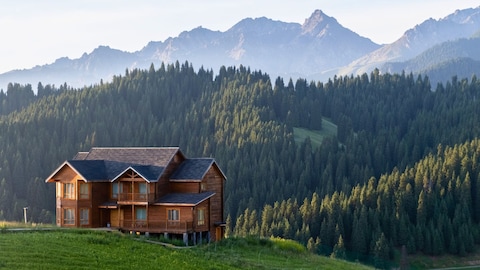
There is a fantasy that seems to have slipped in between the daily struggles of our nine-to-five: buying a house in the mountains. At some point, everyone has dreamt of having a full-fledged cottage in the middle of the hills, surrounded by mountains, with little waterfalls cascading down their slopes, clouds covering the peaks, and mist brushing against us in a soft, cotton-like form.
These fantasies were hyped even more and began taking over our busy schedules when Musafir Cafe took over our Netflix Premium. Originally a novel that has now been adapted into a series, Musafir Cafe has made us realise that peace can be found anywhere. But there is something about the mountains that helps you find yourself, just as Chander discovers after opening his dream café in the hills, and just as Naina from Yeh Jawaani Hai Deewani discovers a new version of herself away from her books and her always-studious persona.
In a world where we are stuck between the peak hours of local trains and the honking of vehicles 24/7, finding peace can feel almost impossible. We can look for it, but somehow never seem to find even a little of it because that is how we have shaped ourselves, and the lives around us.
The idea of slow living, which gets questioned again and again during our working hours, makes us realise something important: slowing down is not about doing less, but about making space for a life beyond the clock.
But, like every coin has two sides, so does everything else. We asked different people what impact the mountains have had on them, and how they see themselves when they imagine living there.
Ruchika Lal, a climate and sustainability communications professional, reminds us that one of the most important things in life is freedom. Whether it is the freedom to wander, speak, or simply make space for ourselves, the mountains seem to hold all of it within them. They provide a sense of freedom, from sitting with yourself and understanding yourself to, most importantly, learning to trust yourself.
She says, “The mountains give you a kind of freedom that is difficult to find in metropolitan cities. In cities, you are constantly surrounded by people, but in the mountains, you get to be more of yourself. When you sit with yourself, you begin to know yourself better. The mountains give you that space, physically and mentally, to reconnect with who you are.”
Sanskriti Painuly, a designer with ancestral roots in Uttarakhand, feels that mountains are a representation of equality. Just as we stretch our faces to look at buildings rising 40 or 70 floors above us, towers and skyscrapers can make us feel surrounded, as if something is always greater than us and we are tiny in comparison. But when we are surrounded by mountains, we feel free.
“When you’re in an urban space, you feel surrounded, not just physically, but mentally. Everything feels clogged: the endless routines, the towering buildings, the constant noise. The scale of the city makes you feel small, but in the mountains, there is a sense of equality between everything. There is nothing that makes you feel small or tiny. Everything feels like you, and nothing suppresses you. They make you realise that you are at the same level.”
Aadyaa Agrawaal, a filmmaker and cinematographer, sees the mountains and the people who live among them through a lens shaped by her profession. According to her, the mountains offer something that today’s generation often struggles to find: a sense of confidence, willpower, and trust in one’s own decisions.
In a time marked by constant self-doubt and uncertainty, she believes that mental and physical well-being can be deeply influenced by the spaces we inhabit. “Being in the mountains gives me a sense of possibility. The vast landscapes make my problems feel smaller, and my potential feel bigger, giving me the courage and willpower to face whatever comes next,” says Aadyaa.
Prachi Dhiren Nagda, a fashion buyer and a devoted follower of meditation and yoga, was brought up in ‘God’s Own Country’, Kerala. She feels that the mountains are a great demonstration of patience. Our grandparents used to tell us that meditation and yoga teach us patience, help relieve negative thoughts, and lighten our seven chakras. The same feeling exists in the mountains. The stillness, the quiet, and the sound of birds chirping teach you to be patient.
“Up there, in the mountains, you slowly realise that not everything can happen according to your plans. The weather can change, the journey can take longer, and sometimes all you can do is wait. You cannot control everything around you, so you learn to accept things as they are and move forward with a little more calm. The mountains remind you that some things simply take time, and learning to wait can be just as important as knowing when to move.”
Nirmayi Janbandhu, a menswear designer and fashion merchandiser who dreams of owning a home in the mountains, feels that living there is not just about peace and slow living, but about reconnecting with our roots. We were meant to love nature and cherish the little details that God has woven into it. Coming closer to the mountains can feel like coming closer to your roots.
“Being in the mountains makes me realise how disconnected we can become from our roots while living in the city. Between busy schedules, crowded streets, meetings, screens, and the constant rush, it’s easy to forget the simpler things that keep us grounded. But the mountains have a way of bringing you back to them. Life feels slower, quieter, and more connected to nature.”
Isha Pandit, a designer and fashion stylist, strongly feels that the mountains hold a sense of divine energy that is rarely felt in cities, except perhaps within temples. There is a sense of God and an energy in the mountains that cannot be explained unless you have experienced it. Being there gives you a deeper connection to that divine energy and strengthens your faith in something greater.
She says, “The mountains make you feel closer to something spiritual, as if there is a deeper connection around you that you cannot quite explain. Perhaps it is the silence, the vastness, or simply the feeling of being surrounded by something much greater than yourself. Away from the noise and distractions of everyday life, you begin to listen more closely, to nature, to your thoughts, and to the parts of yourself you often ignore.”
We have all, at some point, dreamed of owning a house in the mountains, only to leave that dream unfulfilled between work hours and endless meetings. But having a home there is not simply about escaping our fast-paced lives and suddenly embracing slow living. It is about discovering perspectives and parts of ourselves that go far beyond what we usually associate with the mountains.
Image credits: Pexels
Also read: Notes from Japan: A guide to the style, beauty, and culture worth bringing home
Also read: We love ambitious women... until they pick ambition over romance