Zoulfa Katouh wants to change inner worlds with her young adult fiction
Ahead of the release of her second book, 'The Ocean Would Paint Me Blue', Katouh tells Cosmo why cultural conversations are important for the young, and how literature has the power to foster empathy.
Jun 12, 2026
At 32, Canadian author Zoulfa Katouh has impressive accolades under her belt. In 2022, she released her debut novel, As Long As The Lemon Trees Grow, to global acclaim. Inspired by her Syrian descent, the book dealt with the love and loss that transpired during the country’s revolution in 2011. The story was translated into over 25 languages worldwide. In 2023, Katouh went on to win the Amy Mathers Teen Book Award and was shortlisted for the British Book Awards. She was also nominated for the 2024 Yoto Carnegie Medal for Writing.
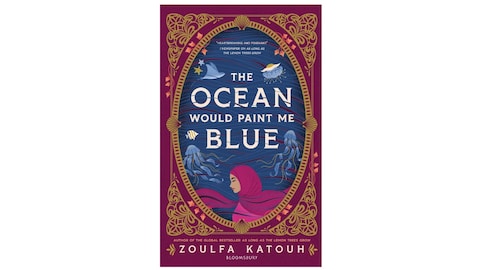
In June 2026, the author is gearing up to release her second novel, The Ocean Would Paint Me Blue (Bloomsbury Publishing India). On a video call with Katouh, I ask if the book launch nerves are setting in. “They tell you never to read the negative reviews, but those don’t bother me. The positive ones that put you on a pedestal scare me,” the Switzerland-based author admits. “I was very in my head while writing the second book, but I’m very proud of it and hope that love translates to readers as well.
The highly anticipated story follows Jihad, a young girl grieving the sudden loss of her mother all while navigating a new high school. As the only hijab-wearing student, she wades through suspicion and loneliness, leaning on her sketch book for comfort and release.
Cosmopolitan India learns why Katouh is drawn to young adult fiction, how themes of loss and resilience flow through her writing, and why she believes more literature needs to explore Islamophobia in the everyday.
The name that you’ve chosen for your book is so interesting. What’s the story there?
For some authors, naming a book comes easy, but for the majority of us, it’s a fight to find a line that encompasses everything the book stands for. The original title was Colour Me Brave, but the word “colour” is often associated with middle grade books. And then my editor highlighted a storyline where the main character talks about her aspirations, and one of them is going to the ocean and it painting her blue.
It’s been four years since your first book came out. Did you plan a long break between the two releases?
My first book was sold on a two-book deal. I always had an idea for the second book; it was supposed to be about a refugee in the West. Unfortunately, while writing, there was one plot line that I wasn’t able to fix. I rewrote it three times, and I was approaching burnout. One day, my agent called me and asked if I’d consider changing the idea, and that’s how The Ocean Would Paint Me Blue was born. That’s why it’s coming out four years later...it was never intended to be so.
Why is it important for you to write YA (Young Adult) fiction?
With the state of the world today, you really want to influence young minds with something good. I want my books to be in schools, exposing children to cultures they probably don’t know a lot about and may not experience in their lives. That’s a way to build empathy.
The protagonist’s name is Jihad, that’s a powerful choice.
A few years ago, on Twitter (now X), I asked why there aren’t more main characters with the name Jihad. In Arabic, it means to strive, to be the best person that you can be. Over time, the word has been associated with negative connotations within the West and Europe. But as an Arab, I don’t see that at all. I wanted to embody the meaning of Jihad in a 17-year-old so people reading can go on this journey and emerge more appreciative of it.
Talk to us about building Jihad’s interior world. Why is she an artist?
With a lot of Muslim or immigrant children, you experience grief in a culture that doesn’t really talk about it. So, Jihad takes all the feelings inside her and puts them in her art. There’s a lot of emotion you can borrow from paintings. I always like to give my characters a little bit of art, whether they like making movies or drawing. I really believe art changes people and how they see the world.
Instead of exploring Islamophobia in conflict zones, the book deals with how it shows up in everyday life.
Of course, sometimes Islamophobia is abrasive chants like “go back to your country.” But a lot of the racism is very subtle. People who leave you wondering: Were they rude? Were they having a bad day, or was it just racism? I wanted to express that nuance with Jihad. She has joined a new school and draws a lot of unwanted attention because she wears a hijab.
How much of your lived experiences seep into the book?
One time I was in France and there was a small issue on the train. My French friend spoke to the conductor and they were very nice. On another day, the same thing happened, but I was alone. I went to the conductor for help and got nothing. It’s death by a 1000 paper cuts. This is the kind of subtle, nuanced xenophobia that I write about. I want the reader to know how it feels to be Arab or Muslim in the world today.
What would you like to leave the readers with before they sit down with the novel?
I don’t want them to read the book as a passive reader, but as a character within the story. You are with Jihad, you see her on the streets and you are with her in school. How do you react to what’s going on? It’s very easy to slip into the role of a bystander, but the world only changes when we change. And some of us have more privilege and more of a voice than others.
The Ocean Would Paint Me Blue will retail in India at ₹499 starting June 2, 2026.
This article first appeared in Cosmopolitan India's May-June 2026 print edition.
Also read: All the books you need to add to your reading list this month!
Read more!