‘It’s multi-orgasmic viewing’: Why everyone’s so horny for period drama porn right now
As Wuthering Heights looks set to give us more sex scenes to add to our roster of favourites, we explore why corsets, rules, repression, and yearning get us so hot under the (billowing) collar.
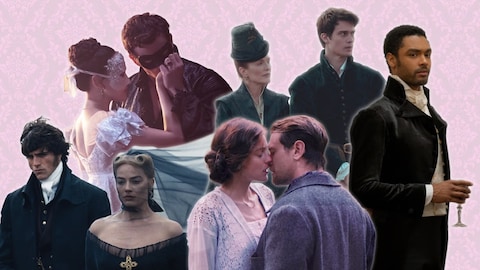
It’s been a long, hot journey for our hero, most of which he’s spent agonising over the woman he loves. As he rides through the forest, soon arriving at his grand estate, he decides to cool off with a refreshing dip in the lake. At the edge of the water, he discards his heavy tailcoat, suffocating cravat, and leaden boots, and, light as a feather, dives into the cool water. When he emerges, dressed only in his sopping shirt and breeches, riding crop in hand… there she is. The woman he desires most. As a jolt goes through him and his heart starts to race, so does ours — the audience longing for them to be together just as much as he is.
There are few TV scenes as iconic as this: Colin Firth’s infamous turn as Mr Darcy in the 1995 BBC Pride and Prejudice adaptation, which Bridgerton recently paid homage to via Jonathan Bailey’s Anthony Bridgerton. And few scenes that arouse, well, quite so many women as this. “There is nothing sexier than a billowing white shirt,” confirms Coco, 30, who credits the brooding Mr Darcy with igniting her hots for period dramas. “I say this as someone rewatching Bridgerton season two for the fourth time.”
Whether your favourite scenes feature men in drenched Regency-era undershirts, there’s never been a better time to be a period drama stan, especially if you’ve got a penchant for a little (or a lot of) sex on the side. In the last few years, historical fiction adaptations and TV shows have been smuttier than ever — from that steamy carriage scene in Bridgerton to a ’lil doggy in Lady Chatterley’s Lover to the romantic queer scenes in Mary & George. And, if the Wuthering Heights trailer is anything to go by, we’re about to get a whole load more to add to our list of faves.
It’s no secret that women in particular are embracing this sexed-up period drama revival, with a 2023 study finding that 42% of women are watching the genre, compared to just 20% of men. And we’re not just leaning into the sexiness of historical settings in film and TV shows, either. As feminist porn studio Four Chambers tells Cosmopolitan UK, audience data shows that their historically-coded work — including a recent film, Some Reddish Work, based on The Crucible and set in the Cumbrian moors in the 1600s — is watched overwhelmingly by women.
But what exactly is it about period drama sex that gets us so hot under the (billowing) collar? Is it that snap of a corset tightening? A stolen glance across a crowded room? The heartache of yearning after an illicit love? And why might these moments be increasingly appealing to younger audiences in our current sexual climate? We know that watching period dramas can be calming during times of political turmoil (hi!), and can even positively influence our mental health and social connections — but what is this added raunchiness bringing to our lives? And what are we wanting when we seek it out?
Women’s pleasure, front and centre
Period dramas are “one of the only places that really put women’s desire and pleasure at the centre”, observes Polina Zelmanova, a PhD student studying representations of sex in popular film and TV. They are typically aimed at women, especially when there’s a romance narrative.
Where most on-screen depictions of heterosexual intimacy tend to follow the same format — kissing then penetration then immediate orgasm — women’s pleasure is rarely, if ever, centred, let alone accurately depicted (we need warming up before penetration, FYI!). This has started to improve in recent years (likely in part thanks to the introduction of intimacy coordinators), with cunnilingus getting more air time than ever — notably in period dramas, including Mary, Queen of Scots, Outlander, and Bridgerton, but also in blockbusters like Don’t Worry Darling, Saltburn, and Marty Supreme. Beyond specific sexual acts, though, period dramas often centre women’s desire in the narrative, prioritising it in non-sexual scenes too.
“Subtle moments of eroticism — whether it’s glancing across the room or touching fingertips — become really heightened and important within the context of the period setting, which is associated with sexual repression and concealment, especially for women,” says Zelmanova. “I call it multi-orgasmic temporality. It’s this constant up and down of tension and release that isn’t just focused on penis-in-vagina sex, but actually takes into account all of these other kinds of pleasures that might be part of someone’s desire.”
“This disperses where we locate sex,” she continues. “It’s not just individual sex scenes, it’s everywhere. It’s in the beautiful, grand costumes and the set pieces; in these small motions that become super erotic.”
This is particularly important to women, whose desire is often shaped by context, emotional meaning, and anticipation, rather than sexual content alone, says Jordan Dixon, a London-based psychosexual psychotherapist. “It’s often the friction around desire, rather than instant access to it, that heightens erotic intensity,” she notes, adding that there isn’t one monolithic female sexual response.
Leaving the world behind
For Coco, longing, build-up, intense eye contact, and anticipation is a major appeal of period dramas, but it is also about the billowing white shirts — and the escapism these costumes, and the setting in general, provide. “It’s fun to get invested in something that’s completely different to your everyday life,” she says. “The language is a lot more considered than any Hinge lines we get sent these days. Chivalry! Courtship! Breeches! It plays into the fantasy of wanting something you can’t have.”
A 2023 survey found that 39% of period drama watchers aged 18 to 34 say the genre has shaped their expectations of romance, while, as per Tinder stats shared exclusively with Cosmopolitan UK, 71% of UK singles aged 18 to 25 want love that feels as intense as it does in films or books. And yet these extravagant worlds, where everything, including people’s manners, is resplendent — and where chivalry is, y’know, still a thing — are the total opposite to the mundanity of relationships and dating today. Meanwhile, the strict social codes and romantic structures of these worlds no longer exist. And, while that’s a good thing in practice, it has taken a bit of that clandestine sex appeal away.
As Coco says: “Because the perimeters are so set within the former — who can date who, when you can sleep with them, and what it means — it adds excitement, in comparison to today, which is much more of a free for all (which is obviously better for actual life).”
At a time when we’re bombarded with sexual images, hyper-sexualised, and accustomed to instant gratification, escaping into a world defined by sexual repression and secrecy, particularly for women, often serves to “make sex fresh again”, as Zelmanova puts it. “Suddenly things that are quite commonplace [today] become raunchy, transgressive, and exciting.”
Taboo obviously plays a major role here — as it does with many sexual interests. In period dramas, erotic power dynamics tend to be shaped by class, restraint, and forbidden love. This is why Vex Ashley, the founder of porn studio Four Chambers, believes period drama porn — as in, actual porn — is still appealing, despite showing you the sex that many films and TV shows only hint at.
“The power of sex is so often in transgression,” she says. “In getting out of your head and away from your polite, public-facing self and into your body, guts, and mess; releasing yourself into an experience, often outside [the realm] of acceptability. The reason why a historical setting is the perfect place to explore this is that the social rules of past society — about decorum and decency — can feel like exaggerated caricatures of the pressures we experience today. Transgressing those rules for the desire of sex feels particularly powerful and taboo.”
Plus, like Coco, Ashley thinks the costumes also help: “[They’re a turn-on] on a purely aesthetic level, but also the sheer effort it takes to get underneath layers of coat and corset to touch skin means you have to be ferally horny.” Not to mention the sexual frustration of delayed gratification, the ASMR of the fabric and corsetry, and, ofc, the bondage element of dresses with laces, boning, and crinolines.
Yearning to… yearn
As well as providing escapism, period dramas may bring up a deep sense of anemoia — a nostalgia for a time we never even experienced — which keeps us coming back for more. “I think a lot of us are feeling fatigued by how [mainstream] porn has shaped modern intimacy,” says 22-year-old Shaira, who describes the car scene in Titanic as having “everything” for her when it comes to sexual arousal (“romance, danger, class tension, adrenaline, release, rebellion”). “Sex can start to feel impersonal or like something you’re expected to perform. Period dramas offer the opposite fantasy: slowness, longing, and being deeply desired. In a dating culture built on speed and access, restraint has become genuinely erotic again.”
In this world, with all its screens, self-optimisation, endless choice and decision fatigue, there isn’t much space for slowness or the anticipation of desire. But with no change on the horizon, we’re forced to look backwards, viewing the past with rose-tinted glasses, and, as Ashley puts it, imagining it as “more tactile, more connected, and less available, therefore more full of intense desire”.
Of course, as we all know, this past isn’t really anything to long for. It might have been sexy to have to hoist up a heavy skirt in a moment of forbidden passion, but we’d also be subjected to all the ills of society at that time too, during which women were entirely subjugated with few, if any, rights of their own. What we’re really longing for when we lust over period drama sex scenes and porn, suggests Ashley, is simply “a release from the tyranny of all this overwhelming choice, and a return to the physical — to yearning rather than having”.
The wet men in billowing shirts help, too, though.
Credit: Cosmopolitan