
The new rules of wearing a shirt, according to fashion insiders
Button-downs are having a way more fun than they used to.

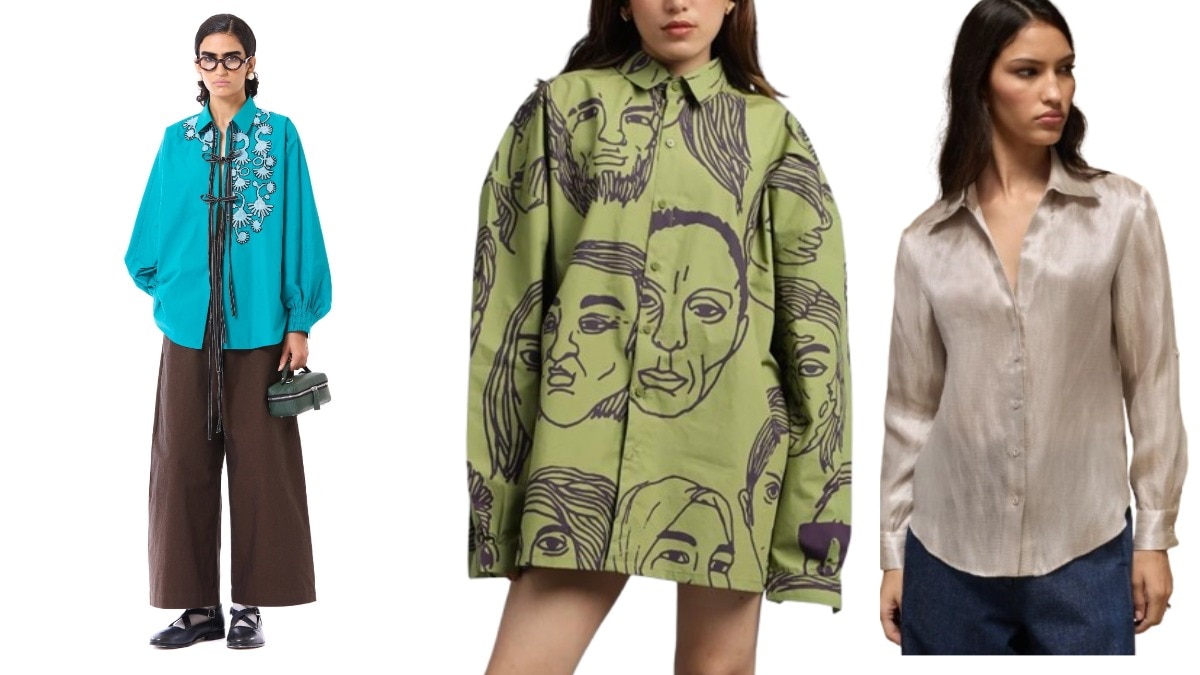
A shirt used to come with a dress code. Buttoned, tucked, ironed. Worn to work and rarely the most interesting piece of clothing in the room. But somewhere between the oversized button-down, the barely-buttoned vacation shirt, and the version styled over a tiny tank for dinner, it lost its instruction manual. Today, it is less a category and more a starting point. It can borrow from menswear, lean into femininity, or refuse the distinction altogether. On recent runways, it has been pulled apart and reassembled through unusual proportions, layering, and off-kilter construction.
Designer Dhruv Kapoor has perhaps the clearest explanation for what happened: “The new-age shirt is without prescription because today’s woman wants to decide what it becomes.” The revised version doesn’t arrive with an assigned occasion; its appeal lies in what can happen to it after you buy it: how you layer it, button it, leave it undone, or mess with it entirely. For Pranav Kirti Misra, co-founder and creative director of clothing brand Huemn, it begins with the shirt’s predictability. “The risk and the joy lie in disrupting that predictability,” he says. A garment once associated with uniformity and conformity is particularly satisfying to reimagine. At Misra’s brand, that can mean an asymmetric placket, inside-out construction, raw edges, or batwing sleeves. “It’s a statement made—even before much is said in the room,” the designer adds.
Getting personal
Senior stylist Ekta Rajani believes the shirt’s evolution can be summed up in a phrase that captures the moment: it now has “main character energy”. Historically, it was often the supporting act, worn beneath jackets, coats, and vests. “It’s no longer playing an internal role, an office role, or a formal role,” Rajani says, adding: “It can be anything that someone chooses it to be.” This is visible in the styling language around it.
The shirt has become boxier, the shoulders have dropped, and layering has moved it into a different category altogether. Rajani points to younger consumers wearing shirts over tanks and ganjis, using half-tucks, and deconstructed buttoning, or treating the garment as a surface for prints, embroidery, personal style, and even political expression.
The details are small, but the shift is not. Rajani sees this especially in how Gen Z wears it. “Their codes of dressing can be quite different from my generation,” she says. A simple shirt can move from casual to formal depending on the hair, makeup, footwear, and accessories—or, sometimes, just the way it is styled.
Texture, please
In India, the story gets more interesting when you look past the silhouette. Simran Lal, co-founder of lifestyle and clothing brand Nicobar, believes the shirt’s ease is determined before it reaches the wardrobe. “You cannot make a relaxed shirt work in synthetic,” Lal says, making a geography-accurate point, placing pragmatism alongside style. “It never photographs well, and it’s unwearable by two in the afternoon.”
Nicobar’s use of cotton, linen, silk, and handloom textiles is rooted in that reality. A shirt has to survive the logistics of an Indian day—morning meetings, traffic, heat, dinner—without requiring its wearer to negotiate with it every few hours. Thus Lal describes a shift from visible signals—the label, hardware or obvious markers of expense—towards “the hand of the cloth, the weight of it, how it behaves after twenty washes.” That logic is reflected in block prints with imperfect registration, chikankari that reads light rather than ornate, and pin-tucks that create interest through structure rather than surface decoration.
Shape shifters
Designer Payal Khandwala, known for crafting a design language that keeps the woman’s body at the forefront, recently put the shirt under a microscope. Her 21-piece edit, The Perfect Shirt, revisits one of fashion’s most familiar garments through different proportions, fabrics, and silhouettes—proving, perhaps, that there is no such thing as one perfect shirt. “A shirt can be interpreted across cultural contexts, and often in ways that feel intuitive,” Khandwala says, adding: “It’s the one staple we all own, which has this shape-shifting quality that makes it the most enduring piece in our wardrobe.” Her approach isn’t about chasing a new silhouette every season. Instead, she describes the process as subtle “software updates” to designs already in her archives—refinements that allow a familiar garment to remain useful without becoming static.
At Dhruv Kapoor, even the question of who a shirt is designed for is deliberately left unresolved. “No product design at our studio starts with a specific gender in mind,” the designer says. Men shop from the womenswear offering, and women opt for menswear staples, with the product ultimately finding its wearer rather than the other way around.
Misra builds on the same idea. At Huemn, these distinctions are largely irrelevant. “Clothes don’t have a gender,” he says. The brand’s oversized signature shirt deliberately breaks away from conventional sizing and can be worn as a shirt, dress, or overlay.
Who's buying?
The people driving this shift aren’t necessarily looking for wardrobe basics —they are seeking pieces with enough personality to make an outfit stand out, and a versatile quality that ensures that it can be worn again and across occasions. Kapoor says younger shoppers are investing in shirts that can be altered through “simple adjustments and DIY details”, with prints, embroidery, and tweaked proportions adding to the appeal.
Lal sees this reflected in the way wardrobes are changing more broadly. They are becoming “smaller and better”, she says, with consumers buying fewer pieces and expecting each one to justify its place. “Ease is the flex now,” she adds. Rajani’s favourite remains the slightly oversized white shirt, tucked in, or worn with a sari. “I just feel like they’re so versatile and timeless that you can do so much with them,” she says. Now that the prescription is lost, the shirt may just become the ultimate rule-bender.
Lead image: The brands
This article originally appeared in Cosmopolitan India's September-October 2026 print issue.
Also read: Has Gen Z stopped raging at nightclubs?
Also read: Is the internet making reading cool again?
more from Fashion

Why we can’t stop collecting scrunchies, even when we already have too many
Is your style seeking you?

Is the “just in case” fashion hack making us dress for plans that don’t exist?
From Chanel to Louboutin, bring runway glamour to your nails with these couture-inspired manicure ideas

Has Gen Z stopped raging at nightclubs?

Is the internet making reading cool again?

Mona Kattan on why fragrance is the ultimate form of self-expression

Cosmo Quiz with Moses Koul: The singer-actor opens up about his icks, controversial opinions, and more
Cosmo Quiz with Prish: The 'Traitors' star on hot takes, makeup icks, and dilly-dallying through life

Are you afraid of your 30s?