
Why Mauritius deserves a spot on every diver’s bucket list
From vibrant reefs and volcanic seabeds to unforgettable sperm whale encounters, experience an underwater world that feels almost otherworldly.

Water is a great healer. Whether it’s the gentle lapping of waves as you watch jaw-dropping sunsets, the quiet rhythm of your own breath underwater, slowing down even when there’s a storm above, or simply finding your ‘earth frequency’, the ocean has a way of putting things back into perspective.
Three years ago, I made a personal pact: learn to scuba dive and return to the sea every year on my birthday, in a new country. Mauritius became my tenth. And it didn’t merely meet expectations; it surpassed them.
My base was Ocean Divers Mauritius in Flic en Flac, a sun-bleached village on the island’s west coast, where we were staying at the Hilton. It was a brilliant choice, with its private beach and luxurious amenities. The dive centre is run by Ravi and his passionate crew, who conduct thorough pre-dive checks and encourage you to do much of the preparation yourself, making the experience feel immersive from the start.
A short ten-minute boat ride takes you above a relatively shallow seabed of 30 to 40 metres at a site known as ‘Aquarium’, one of Flic en Flac’s most beloved dives, named for the extraordinary density of marine life thriving in its clear, warm waters.
What awaits beneath the surface feels like stepping into a living diorama. Deep black volcanic sediments line the seabed, a reminder that Mauritius was born of fire, pushed up from the ocean floor by ancient volcanic forces. Turtles glide past. Eels peer from crevices before ribboning away in search of food. Schools of shimmering parrotfish dart through the water. And then there are the nudibranchs—tiny, psychedelically coloured sea slugs clinging to rock faces in vivid defiance of camouflage.
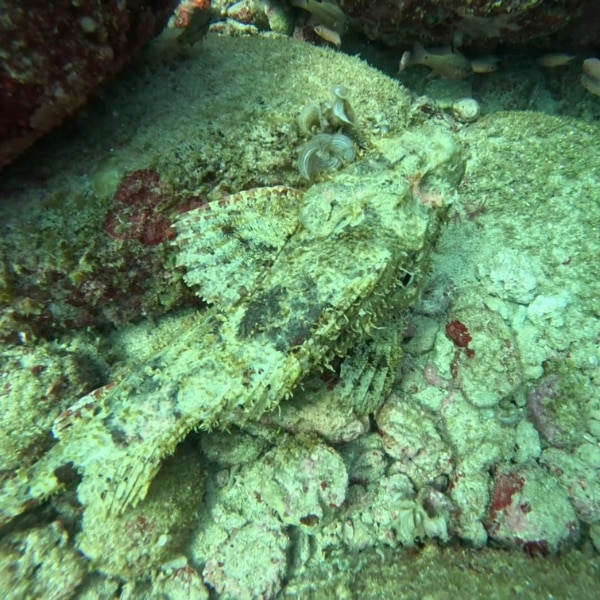
We were fortunate enough to encounter three octopuses, each extraordinary in its own way. One treated us to an almost theatrical display, changing colour seventeen times over three minutes while eating its lunch. We also spotted a stonefish and a lionfish in uncomfortably close proximity—both among the ocean’s most venomous creatures.
Even non-divers aren’t left out. From the boat itself, you can spot ‘Adidas fish’ (surgeonfish with their signature black stripes), hawksbill turtles, and shoals of parrotfish.
The gentle giants of the deep
Mauritius is known, rightly, for its beaches, Creole cuisine, and unhurried pace of life. But the island’s western waters, particularly around the Black River district, hold another extraordinary draw. They are among the only places on earth where sperm whales can be encountered year-round. These resident whales have created a devoted community of marine researchers and conservationists who return to these waters year after year.
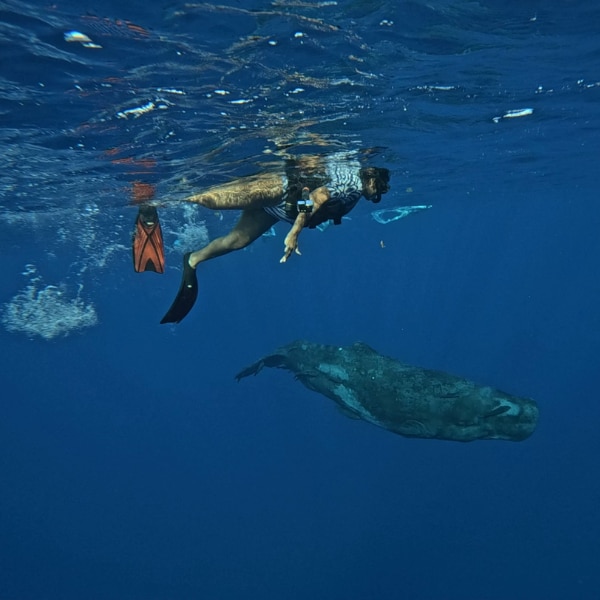
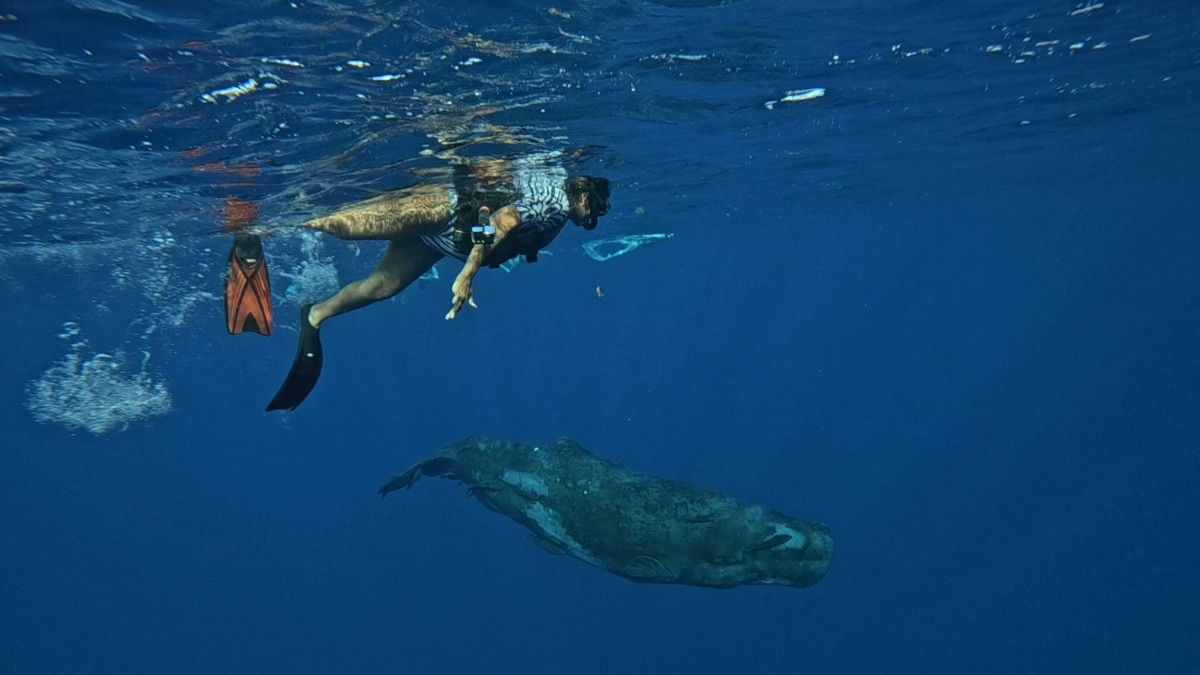
The moment I learned there was a possibility (not a guarantee) of swimming alongside them, I signed up without hesitation. This is not an experience for spontaneity. Bookings need to be made at least a week in advance through designated, licensed operators, and strict regulations exist for good reason, to protect the whales from harassment. Not every season allows it. Not every boat can do it. Conditions matter. Respect for the animals is woven into the experience from the very first briefing.
We departed Black River in the half-dark of early morning, a crew of six or seven, the ocean calm with the sun peeking in slow, graceful moves from the mountains. Within minutes of leaving shore, we were accompanied by a pod of spinner dolphins, and then another, and another. Hundreds of them, jumping from the water on every side, filling the air with brief arcs of silver and their tails. If lucky and time permits, you could get to swim with these pretties, too!
We departed Black River before sunrise, a small crew of six or seven, the ocean calm as daylight slowly spilt over the mountains. Within minutes of leaving shore, we were joined by spinner dolphins. Then another pod. And another. Hundreds of them. They leapt from the water on every side, silver flashes cutting through the morning light. If timing and luck are on your side, you may even get the chance to swim alongside them.
Nearly an hour offshore, our boatman spotted the unmistakable blow of a sperm whale. We hurried into fins and masks, excitement building. But before entering the water, there was a reminder that this experience isn’t for photographs. You need to be a confident swimmer, maintain at least four metres of distance, and pull away immediately if you find yourself in the whales’ path.
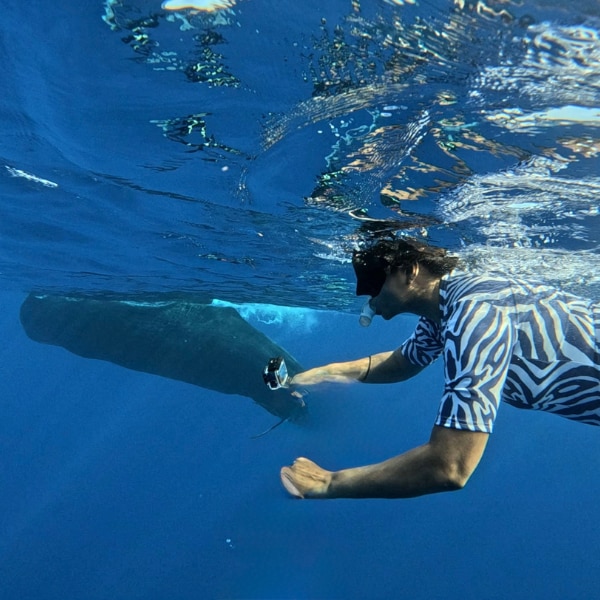
What I witnessed in the water that morning is genuinely difficult to put into words. From the seemingly endless blue ocean below us, a young calf rose vertically toward the surface, its enormous block-shaped head tilting upward with unmistakable curiosity. Behind it came the mother. Approximately 12 to 15 metres long, moving with a deliberate slowness that felt almost time-stopping. We swam in silence as she lingered near the surface for nearly ten minutes before disappearing into the deep. Here's a fun fact: sperm whales are the deepest-diving mammals on earth, capable of descending to 3,000 metres in search of giant squid. Watching one vanish into the deep below you is a subtle reminder, perhaps, of how small our own problems really are.
Then came what our boatman called the real gift. Further along the surface, we slipped quietly into the water above a socialising group of more than six whales gathered together in what researchers call a ‘coda exchange’. To hear them communicating beneath the water—clicks and codas vibrating through your body—is something you don’t merely hear. You feel it.
Over the course of the morning, we entered the water four or five more times. In total, we encountered between twenty and twenty-five whales. Each interaction felt entirely different. A calf slightly more curious. An adult more elusive. One group tightly clustered together, another drifting apart. No two moments felt the same.
If you go—and you absolutely should—book only through licensed operators, follow every instruction from your crew, and resist the urge to treat the ocean’s wilderness as content.
On the boat ride back, we sat quietly, soaking in the enormity of what we had just witnessed. A memory that will sit at the very top of my list. At least until the ocean gives me a reason to rearrange it.
All images: Courtesy of the author.
Also read: Planning your first safari as a couple? Start here
Also read: How to travel Finland like a local, not a tourist
Comment
more from Life

If ‘Off Campus’ gave you butterflies, these romantic dramas should be your next binge

#SaneGirlEra: Anxious, exhausted, overstimulated? Here's a toolkit to calm your nervous system

Why the ‘Other Bennet Sister’ might be better than ‘Pride & Prejudice’ and ‘Bridgerton’

Why 'Off Campus' is the grown-up romance adaptation we needed in 2026

5 zodiac signs who seriously need better boundaries

Gen Z has started making life decisions based on astrology and here’s why

Have we made love bombing dangerously easy to fall for?

The new relationship green flag? A man who is comfortable in the background

What is a ruined orgasm? Experts explain the BDSM practice

“I am a girl’s girl”: Kritika Kamra on friendships, marriage, and making space for women’s stories