Why does Hollywood keep punishing successful women for being too visible?
Zendaya’s packed year is sparking a familiar, frustrating double standard.
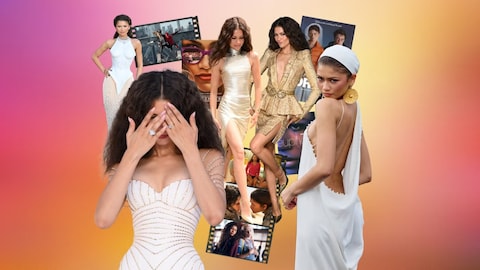
There is no doubt that Zendaya is one of the biggest actors of the moment. Although the third and final season of Euphoria has been criticized to death, her performance has escaped the blows. And, of course, every last one of her appearances on the red carpet is enthusiastically applauded, thanks to the wonderful work of Law Roach, the stylist who has turned her into one of today's biggest fashion icons. However, the fact that she is starring in five major projects this year has tired some people, who are already talking about “Zendaya fatigue.”
The problem is that “being too visible” is something that affects women—rarely men—in Hollywood. As Stylist editor Susanne Norris recently noted, Zendaya “joins the likes of [Anne] Hathaway, [Jennifer] Lawrence, Taylor Swift, and Ariana Grande—all of whom have been targets for being too visible and being among the best at what they do.” Back in 2022, writer and cultural commentator Rayne Fisher-Quann coined a term for this: “woman’d,” which refers to the moment when “everyone stops feeling sympathy for a woman at the same time.” Zendaya’s case is a new example of this deeply misogynistic phenomenon.
While Robert Pattinson, who is also starring in five films this year, is said to be “on a generation-defining streak,” Zendaya—whose 2026 projects include The Drama, the final season of Euphoria, Spider-Man: Brand New Day, Dune: Part Three, The Odyssey, and possibly Avengers: Doomsday—is described as “already tiring” and “everywhere.” However, the truth is that Zendaya herself has acknowledged that she fears people will get tired of her.
“I just hope you guys don’t get sick of me this year because I’ll tell you what—I’m disappearing for a little bit. I’m going to have to go into hiding for just a little bit,” she said during a March interview with Fandango.
Margot Robbie expressed a similar sentiment during a 2024 Deadline interview when asked if she planned to take a break. “I also think everyone’s probably sick of the sight of me for now. I should probably disappear from screens for a while,” she said, adding, “Honestly, if I did another movie too soon, people would say, ‘Her again? We just did a whole summer with her. We’re over it.’”
And let’s not forget when Jennifer Lawrence withdrew from screens for a time due to that same fear of overexposure. “I just think everybody had gotten sick of me. I’d gotten sick of me. It had just gotten to a point where I couldn’t do anything right,” she told Vanity Fair during her 2021 comeback interview, later adding, “I felt like I reached a point where people were not pleased just by my existence.”
The debate over the so-called “Zendaya fatigue” highlights a challenge for women in Hollywood. Although taking part in the industry’s biggest projects in the same year is an unmistakable sign of success, constant exposure can weary audiences. It doesn’t matter if the actress is not only wonderful at her job but also funny and likable: Sooner or later, in an unexpected twist, people can go from love to hate in a fleeting and ruthless way.
Throughout history, women in Hollywood have been judged by a very different standard than actors when it comes to recognizing and celebrating their talent. Too often, successful women are belittled for the qualities people applaud and admire in men. If Zendaya wants to take a break because she is exhausted, by all means, she should. But if she feels the need to slow down when her career is at its peak so as not to bother men who punish her success, we ask her to keep going.