Meet the Nepal skaters turning anime, Y2K and metal music into a fashion movement
Three young women—Lora, Shristi, and Swati—armed with skateboards, tattoos, a love for headbanging, and style that recalls a mix of ’90s chaos and contemporary Gen Z elements.
Dec 12, 2025
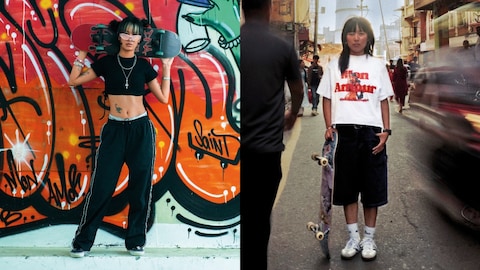
A flannel skirt layered with baggy trousers—also flannel—cinched at the waist with the traditional patuki (waist sash) and her feet firmly on the skateboard. This is how Samiksha Rai—or as her friends know her, Lora, rolls. The 23-year-old’s lacha-tied hair (a decorative hair accessory) sways in the wind as she smiles—all teeth—in a monochrome photograph. In another, her friend dons a tiny bindi as she skateboards in black fishnet gloves and khaki pants—paired with black shoes and white socks.
This is the street style of late teenage and early twenties-something girls skateboarding and headbanging to hardcore metal and hip-hop in Nepal. Lora started skateboarding as a teenager and found herself quite alone as a female skater: “The one girl I looked up to stopped skateboarding and advised me to focus on a job,” she sighs, adding: “It didn’t stop me, and skateboarding is what I pursued after high school.” Not only does this feed into a culture of sport and community, but these women are defining style for a new generation.
“I had a drastic change in my wardrobe after skateboarding,” says Shristi Shrestha, 20, who skateboards with her sister Swati: “I would see the older skater boys wearing oversized jackets, which I really liked.” So, ditching her go-to skinny trousers, Shristi found herself reaching for oversized clothes as it was easier to move in them while skateboarding. She now switches between loose-fitted distressed denims and platforms paired with a tank, or a more punk rock look with torn fishnets and faux fur platforms complete with coquettecore bows.
While she sources most of her clothes from independent stores in Nepal, her sister often opts for the OG skateboarding brand Vans, whose shoes she loves skating in. Lora is often spotted in their cropped tanks, too. And while Nepal has street style stores, Lora has an online shop that sells skateboarding-focused fashion designed by her and two friends.
Skating palette
Lora’s designs are a smorgasbord of everything her friends love, including koi fish and lotus leaves picked from anime, which have been embroidered onto pockets of jeans. She also infuses schoolgirl rebelliousness, using tie as a belt that’s hanging loose alongside more faux fur belts and dangling chains that hold low-rise jeans in place, as if they just stepped off a ’90s hip-hop music video. This, paired with the Gen Z addition of a hand-stitched toy charm attached to the belt, and closing out the look with adidas Sambas. Shristi’s studded belt has a place to add danglers—like a silver heart, which she sports during skateboarding.
In her free time, Lora doubles as a DJ amping up clubs with UK garage, house, ’90s jungle, and bass music. Such alternative music scenes in Nepal also influence Swati. “I like going to hardcore music gigs,” she says, adding: “It’s just very energising and my fashion is also extracted from the hardcore punk and hip-hop scene—which takes a cue from and influences street wear.” While listing out rapper-singers SZA, Lil Wayne, and Cardi B as some of her hip-hop favourites, she smirks, adding that she prefers listening to hardcore metal from Nepal, and that she gets to experience it live. “When you’re listening to such music, there should be a mosh pit ar around to take out your frustrations,” she laughs, and her sister agrees: “We headbang, dance, and throw our hands around. That’s fun.”
When Swati was in India earlier this year, she missed the fest Jambakeet back home, where every urban subculture—including music and skateboarding—erupted in a mass of youthful energy. Nepal doesn’t have many skateparks, but events like Jambakeet attempt to bring the community together (that too in a skatepark). “It’s so sick,” gushes Swati, “Imagine skateboarding, BMX riders, and b-boying happening all together.” There are graffiti artists painting around the venue, making portraits of festival goers and tattooing. Speaking of tattoos: “I have ten,” Shristi shares, “It’s art on your skin that’s never going to leave—that’s just my style.”
Both Lora and Swati are deep into the Y2K rabbit hole, and like the former, Swati also creates clothes—but for now, it’s only for herself. She sends me a photo of a cropped jacket, which she had upcycled from a waistcoat, exaggerating its deconstructed look by stitching white threads along the seams. Both she and her sister are studying fashion design and have scoured through Pinterest looking for skateboarding fashion inspiration, which also led to Shristi learning graffiti. Next up, Swati wants to create a “Lolita look” from the Japanese subcultural movement, with mesh stockings and skirts (but make it goth).
When I spoke to the trio, Lora and Shristi were preparing to go to the Skate Jatra festival in Butwal, Nepal, where a colourful array of galaxy-painted skate wheels caught Shristi’s attention, as she watched competition participants ollie into the air and jump above roaring flames of fire. She also noticed a collection box that had been set up by Skate Aid that organises the festival, to encourage more girls to skate. This lack of representation also inspired Lora to start the skating community, Girls Skate Nepal, which has since grown, with the group travelling together to skating events. “When we did our first workshop in Kirtipur (Nepal), we thought very few girls would come,” she says, adding: “But nearly twenty girls came, and that made me very happy.”
Images: Satya Mahalik, DNA Culture Nepal, and Leina Sharma
This article first appeared in Cosmopolitan India's November-December 2025 print edition.
Also read: Get, set, go(ld): Parul Chaudhary on becoming one of India’s top steeplechase athletes
Also read: Simone Biles Wasn't the Only Athlete to Open Up About Mental Health at the Tokyo Olympics
Read more!