Same trousers, same top cut—how the repeat silhouette is turning outfits into personal uniforms
Why fashion’s most confident move right now isn’t variety, but returning to the same shapes again and again.
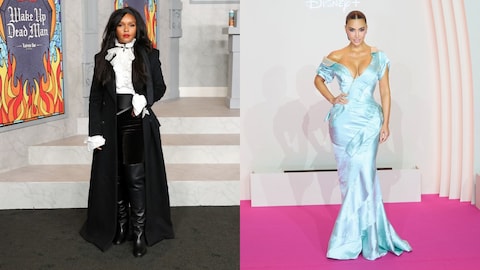
From Kim Kardashian’s sculpted body-con dresses to Janelle Monáe’s tuxedo-first uniforms, pop culture has long understood the power of a recognisable outline. These figures aren’t remembered for single outfits, but for shapes; the silhouette becomes shorthand for identity. That logic has quietly trickled down to everyday style. People are returning to the same cuts and proportions not out of habit, but because clarity, comfort and recognisability have become the ultimate currency in a world of visual overload.
Scroll through any feed or step onto any street, and the pattern is hard to miss. Style today isn’t about surprise. It’s about certainty. In a culture saturated with references, repetition now signals self-knowledge rather than stagnation. What once felt safe reads as intentional. The repeat silhouette has become fashion’s power move.
At the heart of this shift is a recalibration of what style is meant to do. Less spectacle, more alignment. Less novelty, more identity.
Familiar ground
For many, the move towards repeat silhouettes doesn’t begin with theory, but with lived experience. “Once you find a shape that works for your body, looks good in pictures and feels aligned with how you want to be seen, it creates a sense of comfort and trust,” says stylist Tanya Doshi. That trust simplifies getting dressed and sharpens personal style in the process.
When the silhouette is settled, the focus changes. “You’re no longer stuck on whether something works or not,” Doshi explains. “The attention moves to fabric, texture, layering and accessories.” Repetition, here, isn’t dulling—it’s clarifying. The look feels considered rather than tentative.
Creator Shubhra Vaity arrived at this clarity over time. “It came after a long phase of trial and error,” she says. “I started out dressing very street style because that’s where everyone was headed.” Slowly, instinct replaced imitation. Today, her wardrobe revolves around tailored trousers and clean proportions—pieces she gravitates back to even when she tries to deviate. “When people kept asking me where my trousers were from and I’d say they weren’t new, I knew I had settled into something.” Recognition, it turns out, doesn’t come from constant change. It comes from coherence.
The language of comfort
Comfort has become fashion’s most persuasive argument, but its meaning has evolved. It’s no longer just about ease; it’s about emotional alignment. Designer Prernaa Lohiya of Something Sustainable believes today’s consumers are far more visually literate than before. “In a market that feels increasingly cluttered, knowing what truly works for you helps cancel the noise,” she says. “Familiar silhouettes become a foundation, not a limitation.”
That foundation gives people permission to dress on their own terms. “Comfort today is deeply personal,” Lohiya explains. “It could be how a fabric feels on the skin, the ease of a silhouette, or the emotional pull of a colour.” When those elements align, style feels instinctive rather than performative.
Creator Sneha Das sees this play out intuitively. “Whenever I’m confused with styling, I consciously stick to a particular style that has worked for me,” she says. For her, repetition isn’t strategy—it’s balance. “I realised it gave my body type and height a perfect proportion, like it was meant for me.” Once that silhouette is repeated, recognisability follows naturally. “People start relating your personal style with that shape,” she adds. Comfort and visibility begin to work together, not against each other.
Shapes that stay
Repetition was once dismissed as a lack of imagination. Now, it reads as discernment. “Earlier, repeating silhouettes was associated with playing it safe,” Doshi notes. “Today, it communicates confidence and self-awareness.” In a fashion landscape defined by constant churn, choosing what works—and sticking with it—signals clarity.
For Vaity, that clarity shows up in restraint. “When you stop chasing every trend, you begin refining instead of reinventing,” she says. “A familiar silhouette lets me express taste and intention.” The framework stays the same; the nuance shifts. Fit and tailoring, however, remain non-negotiable.
Lohiya sees this return to repetition as part of a wider cultural reset. “Repetition is no longer a taboo,” she says. “It’s a confident choice.” In a world that moves at relentless speed, returning to the same silhouettes can feel grounding. “It isn’t habit,” she adds. “It’s identity.”
That’s why the repeat silhouette feels so resonant right now. It resists the pressure to perform fashion endlessly and instead prioritises longevity, recognition and ease. Even when silhouettes are borrowed, individuality still surfaces. As Das puts it, “If you put yourself out there, it’s bound to be copied. But I love when someone’s own sense of identity blends with it.”
Fashion, it seems, is less interested in how often we change and more curious about what we return to. The rise of the repeat silhouette isn’t about wearing less. It’s about knowing more—about your body, your taste, and the shapes that feel unmistakably your own.
Lead image: Getty Images
Also read: The curvy girl’s guide to wearing every “scary” trend—and absolutely owning it
Also read: What your Hinge shelfie secretly says about your love life