Is it just us? Or are the single cat ladies happier?
As more single women proudly embrace their lifestyles, we’re reexamining the relevance of the age-old insult once used against them.
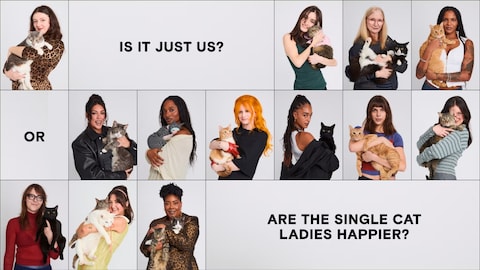
They’re everywhere. Year by year, the population of happily single, never-married, and not-particularly-pressed-to-be women expands rapidly. A Morgan Stanley study predicts that by 2030, 45 percent of women ages 25 to 44 will be single. A Pew Research Center report found that only 34 percent of single women in the U.S. are actively seeking romantic relationships and that almost half of American women say marriage isn’t essential to a fulfilling life. Meanwhile, high school–aged girls are now, statistically, significantly less interested in marriage than they were 30 years ago. It’s been decades since a woman’s access to capital and property depended on marriage. But in recent years, it’s become clear that our relationship status bears less weight on our social stock, too. And thus, age-old insults and epithets threatening “spinsterhood” just don’t carry the same weight they used to.
Every version of the “lonely single cat lady” dig has almost entirely lost its belittling punch: “the lesbian cat lady,” “the crazy cat lady,” “the old cat lady,” even “the childless cat lady,” a stereotype that now-Vice President JD Vance leaned on during the 2024 presidential campaign to disparage Democratic leaders who dared to never bear children. After all, is it not sadder and lonelier to settle for a relationship that depletes your time and energy out of fear? There is power in investing your attention elsewhere and choosing to pour your love into an animal that won’t embarrass you or take advantage of your domestic labor—an animal known to be far more discerning about whom it delegates its affection and loyalty to, no less (Emily Brontë famously once described cats as an “animal who has more human feelings than almost any other being.”). Not only has female singlehood become more socially acceptable, but it has also been deemed worthy of romanticization. The same stereotypes once wielded to call women’s worth into question are now heralded as aspirational. (Parse through the many “single cat lady” moodboard images on Pinterest.) Single celebrities like Tracee Ellis Ross are regularly celebrated for their independent lifestyles, and last year, the passing of actor Diane Keaton was marked with several viral loving remembrances that lauded her for never marrying.
The shift from insult to inspiration comes down to choice. What you’ll find when talking to single women, especially those who are decidedly “not looking for a relationship right now”—and even more so those willing to be photographed and branded as single by a national media publication—is a deep respect for personal agency. Yet still, the concept of choice was what the 13 proud single cat ladies we spoke to cited as the most commonly misunderstood aspect of their relationship status. Despite the growing disinterest in life without a partner, too frequently, their decision to stay solo—prioritizing career, friendships, family, or pets, and more specifically, cats—is treated not as an intentional decision but as a consequence, a supposed result of dwindling desirability, dating-app fatigue, a manosphere-driven scarcity of like-minded romantic options, or the rise of the multipurpose buzzword heterofatalism (defined as the belief that all heterosexual relationships are unsatisfactory and doomed to fail).
That’s not to say these cultural forces play no role. But that sort of pathologization can overshadow the agency that roots their decision. And what these women—steadfast in their loyalty to choice—insist is that their personal decisions supersede such externalities. Their time and emotional energy are theirs to allocate, and they can choose to pour them entirely into whatever they so wish, including their beloved cats.
“For women to feel mandated to fulfill their normative gender roles and for marriage to be attractive, it must satisfy social and psychological needs beyond the sexual and structural functions,” says Kimberly Martinez Phillips, PhD, a visiting scholar at the Centre for Feminist Research at York University. “The rise in single women can be attributed to a higher level of independence and expanded freedoms that feminism has helped produce,” she explains. “So women are reframing singlehood as a legitimate choice in opposition to marriage and not as a character flaw.”
At the risk of making sweeping generalizations that overlook the emotional and situational nuances shaping every individual’s relationship status, no, not every single cat lady is happier than every person who’s found honest, fulfilling love. There is no universal measure of joy. But if your idea of true happiness is determined by the level of understanding and gentle companionship someone has in their life, we’d argue that the single cat ladies have found it.
Jinkx Monsoon, 38 + Myrtle-Lu Monsoon, 2
Occupation: Actor
Social handles: @thejinkx, @jinkxmonsoonofficial
Cat’s breed: Ragdoll and Maine coon mix
When and how did you adopt your cat? When she was almost 2 months old. A fellow practicing witch was fostering Myrtle’s litter when I posted that I was looking for a cat. Her foster mom reached out, and I adopted her through the Emerald City Pet Rescue.
Best part of being a cat owner? Waking up next to your purring cat
How long have you been single? A little over 2 years
Most tired cliché about single women? That we’re unhappy being single
What do you cherish most about being single? Going to bed whenever I want without anyone commenting on it.
Do women thrive single? I think women thrive. Single, married, partnered, poly—we persist, and we thrive.
What qualities does your cat have that you’d appreciate in a potential partner? It’s zero pretense with her. She’s very direct and communicative. Every meow is a message.
What would your cat warn a potential partner about you? She doesn’t do well with too much free time.
Credit: Cosmopolitan