
To dye or not to dye: should you embrace premature greying or cover it up?
Whatever you choose—remember you are the mane girl, regardless.

We don’t really know who said it, but whoever invented the term ‘wisdom highlights’ is a genius. It makes one think of a very, very smart woman (only a woman—for reasons known and unknown), on a plane ride to a holiday resort that costs as much as most people’s monthly salary. Composed and unarguably assured in her travel co-ords, just a smidge of makeup on her flawless skin, and accompanied by said wisdom highlights in her hair—strands of grey poetically woven into her dark locks. Makes one think of someone who has achieved a thing or two, paid off all her loans, has a personal Pilates instructor, and carries homemade almond milk wherever she goes. Just in case.
However impactful the wisdom here seems, the truth is much less exciting. Having greys, especially in your 20s or 30s, is a complicated affair, and brings with it a kind of insecurity that you get mad at yourself for. What about all the body positivity Reels that you scroll all day long, or the late-night conversations on body image that you have with your kind friend, ChatGPT? Well, it’s not just you. Pop icon and actor Jennifer Lopez has told news publications that she started greying prematurely in her 20s, and has since touched-up her roots every single week. She is now 56, and looking at her, it seems her ritual continues with perhaps more nourishment, tech-savvy tools, and new-age treatments to the rescue. She is JLo, after all. While the salt-and-pepper look on men had millennials swooning over George Clooney and Dr McDreamy (actor Patrick Dempsey in Grey’s Anatomy), the women didn’t have any such luck.
So let’s recap—if you are a woman with hair that has been prematurely greying for a while, and you are stuck between “owning it” and paying your salon guy every other week for that confidence-redeeming colour job—you are not alone.
Grey is the way
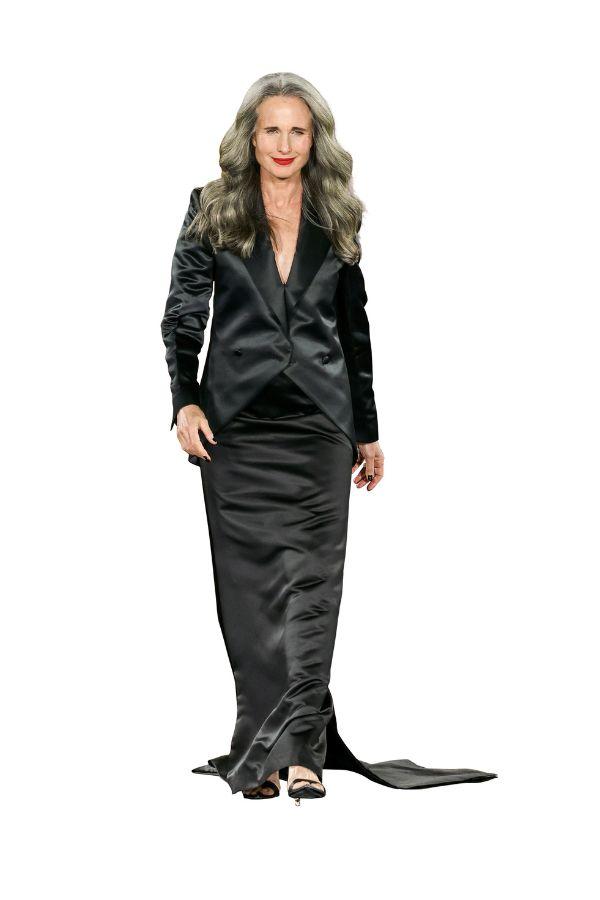
Don’t get us wrong—there are enough examples out there to prove that if you give up on trying to cover up grey strands (or some of those confident silver ones), you will still have the ability to own a room. For instance, actor Andie MacDowell, who stopped colouring her hair, walked international red carpets with her gorgeous grey mane, and has become a spokesperson of sorts for those ditching colour. “It’s not that I’m trying to advocate for not colouring your hair. I think it’s a lovely choice. You have to do whatever makes you happy. I’ve enjoyed (being grey) for my work. I think it’s more interesting to play someone who truly looks my age,” the 67-year-old told Good Housekeeping this September. Makes sense. What MacDowell does is exemplify a healthy hair trend, not advocate for it stridently—a balance actors like Jennifer Aniston have also spoken about in interviews.
But, what about younger celebrities? Because that’s often where the grey hair conversation gets tricky. Being in the public eye inspires a standard of beauty which is often unrealistic, and frequently tied with one’s image as an artist and all that they represent. American singer Becky G is like a breath of fresh (h)air, having shared that she has had grey roots since she was 14. Many TikTok videos pay tribute to her confidence, with Reddit threads dedicated to how the 28-year-old inspired them to own their roots, too—literally and metaphorically. Often, grey hair carries its own weight, which can be cultural, societal, and even personal, and it’s good to discover a muse who puts it all into perspective.
We are all tired
In the past few years, multiple studies have alluded to the fact that disruptive lifestyles and nutritional deficiencies are making younger generations age faster. This includes greying. American integrative health coach Catarina Orr-Lee made digital headlines when she garnered millions of views on her TikTok earlier this year to highlight mineral imbalances in the body as the reason for premature greying.
Stress has also historically been seen as the leading cause—and it’s also scientifically sound. A study published in 2021 by researchers at Columbia University Vagelos College of Physicians and Surgeons found that not only did stress add to the greying of hair, but eliminating it also led to reversing it. “Just as the rings in a tree trunk hold information about past decades in the life of a tree, our hair contains information about our biological history,” the study’s senior author Martin Picard told Columbia University Irving Medical Centre. He added: “Understanding the mechanisms that allow ‘old’ grey hairs to return to their ‘young’ pigmented states could yield new clues about the malleability of human ageing in general, and how it is influenced by stress.” That’s good news for Gen Z—a generation cited as the most stressed (especially at the workplace) by multiple research and studies.

Reversing grey hair is one thing, and maintaining it is another. The grey hair blending technique helps with the transition (it’s an art, really), balayage, fine foils, lowlights, and a soft root smudge help merge your natural greys with tones that flatter them—cooler blondes, gentle browns, or subtle silvery shades. The colour feels grown-in, rather than covered up.
Keeping, covering, colouring, cropping—by the end of it, it’s the choice we make. And, all of them are valid.
Images: Shutterstock and Getty Images
This article first appeared in the January-February 2026 print issue of Cosmopolitan India.
Also read: The rise of Brotox: Memes about male celebs looking *different* are rife - what's really going on?
Also read: The skincare edit you need if your your job involves eight hours of screen time and counting
Comment
more from Beauty
Meet anti-blush, stained glass lips, and 4 other trending makeup looks for fall

I deleted Instagram for two months and forgot what was wrong with my face

Dear universe, when am I going to get a boyfriend?

Inside the sexual fantasy forums where women share their deepest desires

Are you too independent to be loved?

We know what a healthy relationship looks like, so why do we keep making excuses for the unhealthy ones?

Beyond the metros: Smaller cities drive over half of Amazon’s festive fashion and beauty orders

Is the fear of falling first ruining modern dating?

Everyone wants a “low-maintenance relationship” until they’re actually in one
Unique gifts for every personality: Meet them where they are