
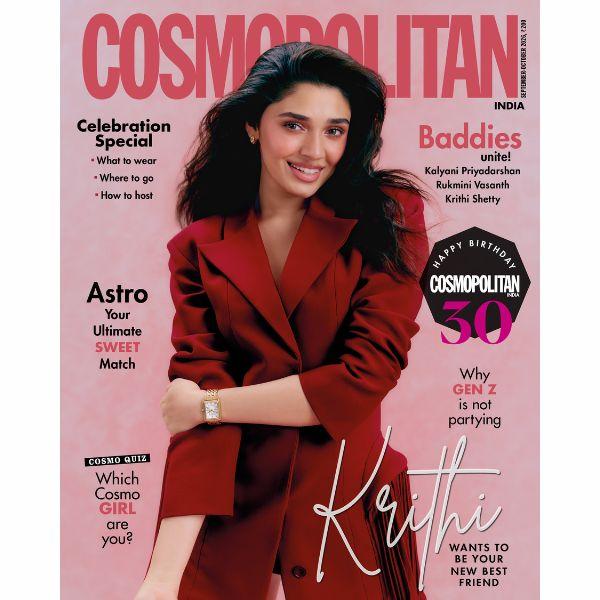
Krithi Shetty is your new best friend
The actor is the ultimate Cosmo girl—approachable, clear-headed, and ready to take on the world. We chat with her on method acting, private rituals, and waiting for her dream role.

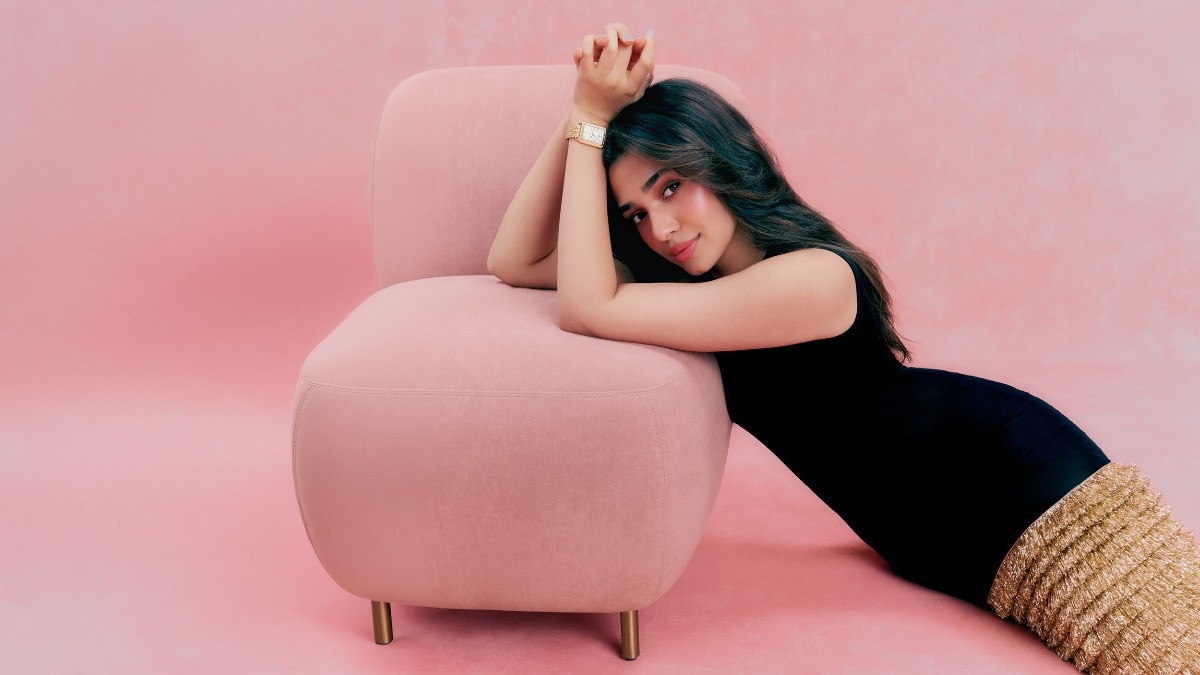
It is 11 am on a Sunday when Krithi Shetty appears on my screen. She is wearing a blue maxi dress with her hair down and some makeup on, and she is thinking about food. The 23-year-old actor tells me blithely that an eleven-course meal is waiting for her after we hang up. It stops being a regular interview after this admission. Shetty is inquisitive about my life too, the way you’d be about a friend’s—and during our call, we end up becoming one.
Her actual friends, though, will tell you she’s a bad influence, always the one lobbying for dessert, or a bigger portion. (She does Pilates and some form of dance—Kathak, currently—to burn off those calories; it’s all about finding that balance Gwyneth Paltrow talks about.) However, Shetty has never quite learnt to want less—of food, or of experiences.
She was only 17 when she debuted in a lead role, in the Telugu romantic drama Uppena, in 2021. Before that, we saw her in a string of ad films and a blink-and-miss appearance in Hrithik Roshan’s Super 30 (2019). It was on the set of one such ad in Hyderabad that a stylist spotted her and pitched her to a casting director, which is how she landed Uppena. There was just one problem: Shetty, a Tulu-speaker, couldn’t read or speak a word of Telugu.
Method to the madness
A quick study, Shetty took Telugu lessons and would show up to sets with her dialogues memorised (and everyone else’s too), to understand the scenes better. It’s in keeping with a career built on elaborate private rituals. “I would never want to overstep the filmmaker’s vision,” she says of her process, “but based on what they’ve told me about the character, I can recognise patterns and make a whole characterisation from it, which is just for me.” Sometimes that means making a playlist around the character, other times it’s a fragrance associated with them.
It’s a strange kind of invisible labour for someone whose job is, definitionally, to be seen. But Shetty was, by her own account, the least visible person in the room for most of her childhood—an introverted only child raised by two Mangalorean extroverts in Mumbai, “my parents would often wonder if I am their kid.” Her mother, Neethi Shetty—a fashion designer, and now her manager—spent her one day off every week driving Shetty an hour and a half each way to ballet class, “so I could have the life that she never got,” she says, with gratitude. And by 11, she was doing advertisements for pocket money, standing in audition rooms with 200 other kids, doing the math on her own odds. “I used to think that there was no world in which I would make it in this industry with zero connections,” she says, adding: “That’s when I sort of gave up that dream, but then life happened, and I got to do this.”
But doing this was never going to be enough—the Virgo that she is, Shetty needed to do it right. She has been careful not to let herself get pigeonholed into the sweet-village-girl mould that followed her first film. Her second project, Shyam Singha Roy (2021), cast her instead as a city girl who rides a bike and smokes in her opening scene—“a whole other story,” she says, laughing it off—chosen specifically because it wasn’t more of the same. She names the late Sridevi as an actor she measures herself against: someone who “could pull off anything... you believed it was actually happening.”
Jeremy Strong (the actor who played Kendall Roy on HBO’s Succession) has taken plenty of heat for how seriously he takes his method acting, in part because Kendall himself was such an insufferable character (for most). It begs the question: does the same scrutiny apply when the character in question is sad for instance, rather than annoying? In her recent role as an influencer who breaks down over a post that didn’t get enough likes, in the Tamil film Love Insurance Kompany (2026), Shetty found herself unable to relate to that particular anguish at first. So, she spent the entire day on set staying sad, sitting with the feeling, and journaling and by the time cameras rolled, tears came naturally.
Emotional roles, she says, are her area of expertise. It’s comedy that frightens her more, because the timing there can’t be faked. Her dream role, though, is something else entirely: a princess warrior, complete with a Pinterest board she has already made in anticipation. “I’m just waiting for someone to show up at my door with that role and I can possibly go on floors in like two weeks because all my homework is already done.”
Theatre of life
Shetty is aware that such roles don’t come easy in the South. Having been in lead roles in movies across Tamil, Telugu, and Malayalam cinema, she has consistently played the male protagonist’s love interest. “If you look at the people at the top, like filmmakers, a majority of them are men,” she explains. Does she wish this would change, that is, more female-led projects, or more women on sets in general? Without question—she even hopes to direct someday. But until that happens, she would love to play an unlikeable woman. “Someone like Piku, whose perfections or flaws aren’t drawn out or exaggerated,” she shares. “Men don’t have to do much to be liked in society (or on the big screen), but for a woman, even if she’s perfect, people will still find flaws in her,” she continues.
Shetty is currently juggling a Telugu and a Tamil movie, alongside a psychology degree via distance learning through the National University of Open Schooling, something she picked up specifically to get better at learning about the inner worlds of her characters and the behaviours they exhibit. “I chose psychology for the love of acting,” she clarifies, “because I love my job so much I want to do everything I can to be a stronger performer.” But apart from her craft, what really matters to Shetty is bringing about real change in people’s lives. “I would always want to be remembered because of the person that I am and inspire someone to do something good.”
By the time it’s 12:30 pm, we both (Freudian) slip out of our assigned roles as journalist and celebrity, and into something less professional: two people awkwardly asking each other out on a friend date.
Editor: Snigdha Ahuja (@snigdha.ahuja)
Interview: Ananya Rai (@anniiiiiiiee)
Photographer: Aastha Manchanda (@manchandaa)
Stylist: Nishtha Parwani (@nishthaparwani)
Cover Design: Mandeep Singh Khokhar (@mandy_khokhar19)
Makeup Artist: Savleen Kaur Manchanda (@savleenmanchanda)
Hair Artist: Sourav Roy (@souravv_roy_)
Editorial Coordinator: Shalini Kanojia (@shalinikanojia)
Fashion Assistants: Maitri Desai (@maitriidesaii) and Ria Kothari (@ria.kothari)
Fashion Intern: Siddhi Goswami (@styledbysiddhig)
On Krithi: Blazer dress, Āroka (@arokaofficial); watch, Raquel Three-Hand Date Gold-Tone Stainless Steel by Fossil (@fossil.in).
Comment
more from Celebrity
Kalyani Priyadarshan is ready to take over
Vikrant Massey is finding his way home

Why do men love being haters on the internet?

Type 3 fun, sunrise views and benne dosa: a Gen Z cheat day checklist

The biggest bridal diet mistakes nutritionists wish women would stop making

13 tips for better sex, according to experts

Hair spa treatments to book when your hair needs a little extra TLC

Is “digital jealousy” impacting your relationship?

Sorry 'The Love Hypothesis' fans, but Dr Adam Carlsen is not exactly a green flag

The restaurants putting India’s regional food on the map