
Can egg freezing buy you more time? Here's why women are embracing the procedure
I turn 28 this year. My biological clock is ticking—or so they say. Yet, in a generation of intentional parenting and delayed motherhood, what power does that clock really hold?


Egg freezing isn't a solution to society’s timeline, but a negotiation with it. Whether it be the pursuit of career progression, indecision, or simply not having found “the one”, women across cultures and continents are turning to it to reclaim reproductive autonomy and loosen the leash on maternal expectations. And in a world plagued by the anxiety of “falling behind,” perhaps it’s all the more appealing.
Reclaiming time
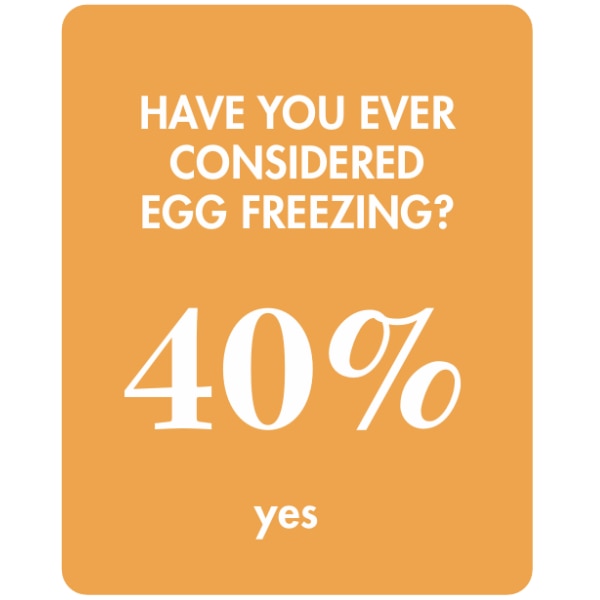
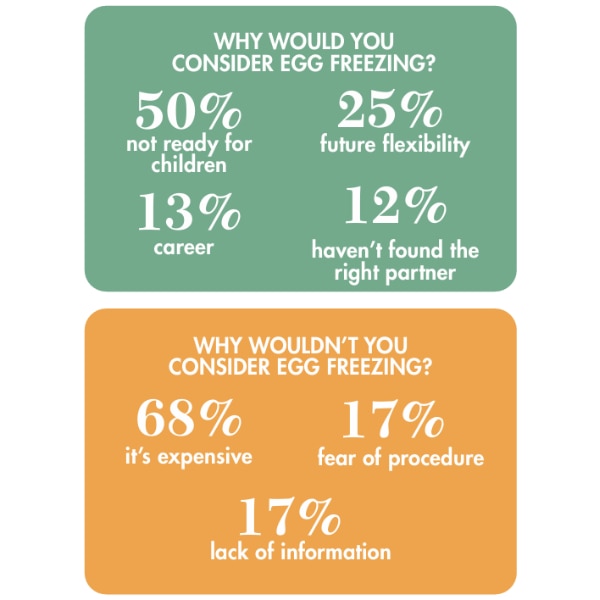
In an Instagram survey conducted by Cosmo India, 50 per cent of readers said they aren’t ready for children yet, while 25 per cent expressed a desire for future flexibility.* Delhi-based Simran Arora, a 28-year-old creative director, cites stalled career growth as the reason behind her decision to freeze her eggs. “I’ve seen marriage and children slow down careers,” she says, adding: “I want to freeze my eggs by next year...I’ve already begun the process.”
But from the outset, Arora was met with moral policing. “My then-gynaecologist said, ‘You’re young. Instead of seeing multiple partners, you should just settle down.’ I don’t think it’s something that should be moralised, especially when you’re bringing up egg freezing,” she adds.
Our readers echo this sentiment. Forty-three per cent are not sure whether egg freezing is socially accepted, but believe “fertility talk” should be routine in our 20s and 30s.*
Fertility in focus
Going beyond the confines of clinics, celebrities, too, have helped bring fertility conversations into the mainstream. More recently, actor Akansha Ranjan Kapoor unpacked the physical and emotional realities of egg freezing on actor Soha Ali Khan’s podcast, All About Her. Actors Priyanka Chopra Jonas, Paris Hilton, Emma Roberts, and Amy Schumer have also spoken about freezing their eggs.
Dr Anshika Lekhi, a gynaecologist and fertility specialist at The Fertilife, Gurugram, makes a strong case for open conversations around fertility in India. “Over the last few years, there’s been a major shift towards social egg freezing—done for non-medical reasons—especially in metropolitan cities. It reflects a generation trying to balance biology with modern life realities,” she explains. That said, it’s no insurance policy for eventual parenthood.
“No procedure can ever guarantee a pregnancy. But, oocyte cryopreservation, colloquially known as egg freezing, presents a fair chance—with a success rate of 40–60 per cent if done at the ideal age,” adds IVF specialist Dr Yuvraj Singh Jadeja. A whole lot depends on uterine health, egg quality and quantity, and sperm quality. Egg freezing creates an opportunity; it’s not a guaranteed backup plan.
He also underscores the distinction between egg freezing and embryo freezing, the latter being far more common. “Married women, or those with a stable partner, often opt for embryo freezing—a technique combining the egg and sperm to create an embryo that is preserved. It’s usually safer, and pregnancy rates are slightly higher,” he shares. But it’s important to note that if the relationship is no longer viable, it could complicate questions of consent and future use.

Beyond choice
Beyond reproductive reassurance, egg freezing may also offer a sense of psychological relief. While for some it’s empowering and proactive, for others it’s practical planning. The decision may also stem from anxieties around age, relationships, or societal pressure. “Often, it is a combination of all three,” adds Dr Lekhi.
Yet, not all fertility journeys are rooted in choice. Dr Jadeja explains that certain medical conditions—such as endometriosis, cancer, or treatments involving immunosuppressants and steroid medication—may also prompt women to preserve their eggs. “Social egg freezing is on the rise owing to greater awareness. But when it comes to medical egg freezing, awareness still lags. Perhaps medical professionals beyond gynaecology need to consider the fertility implications of the treatments they prescribe,” he says.
For Meera**, however, egg freezing emerged in response to personal upheaval. The 41-year-old journalist chose to freeze her eggs in her hometown of Lucknow amid a divorce. “As the legal proceedings were underway, I realised I wanted the option of having children in the future,” she says, adding: “Had I divorced at 25, I wouldn’t have given it much thought. But after 35 your fertility dips sharply. You can’t fight science.” She was 38 at the time.
Future forward
Unlike conventional narratives around fertility, for both Simran and Meera, the decision was deeply personal— untethered to familial obligation or social pressure. But, when asked whether they would choose to use their frozen eggs as single parents, Meera shares, “That calls for guts...especially in a country like ours. It comes with its own economic, emotional, and social pressures.”
Reproductive autonomy seldom exists in isolation—inevitably seeping into the dynamics of love and long-term relationships. While Simran is seeking partners who share the same level of emotional maturity when it comes to such matters, Meera reveals it was among the first conversations she had with her current husband.
“We both wanted children. The option should be available, should we choose to exercise it,” she says, adding, “So, I was like, ‘Okay, I have control over my future. It’s a decision I’m sure about, and I will act on it if required.’ There was no pressure.” Since then, Meera has conceived naturally twice, though both pregnancies ended in miscarriage. “Now, we’ve decided to take the IVF route.”
Cost of delay
Interestingly, not everyone who freezes their eggs ultimately returns to use them. While there’s no clearly defined “expiry date” if storage conditions remain stable, some women may eventually conceive naturally or change their reproductive plans. But peace of mind does come at a considerable cost.
“Buying time” isn’t feasible for everyone. Women must consider the financial costs of stimulation medication, procedure charges, storage rentals, and future IVF fees. “In metro cities, expect to pay anywhere between `1.2–2.5 lakh per cycle, which covers consultation, hormonal injections, monitoring scans, freezing charges, and the egg retrieval procedure.
In non-metros, costs can range between `80,000–1.5 lakh per cycle,” Dr Lekhi shares, adding: “On average, women need no more than two cycles, but those with lower ovarian reserves may require multiple cycles, bringing up the total expense.” Meanwhile, storage charges typically range between ₹10,000 and ₹50,000 annually. Costs vary based on clinic reputation, lab quality, medical requirements, and the number of cycles needed.
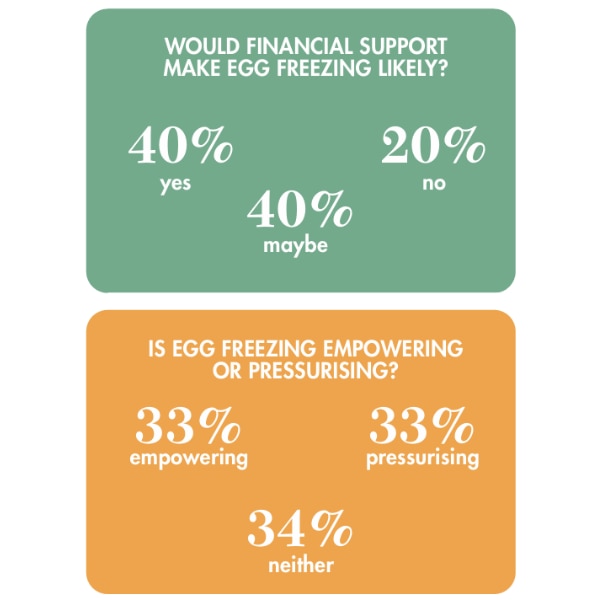
Turns out, 68 per cent of Cosmo India readers say they would avoid egg freezing because it is expensive, with over 40 per cent suggesting that financial aid would make them more likely to consider it.* You see, standard health insurance policies do not cover fertility treatments as they are considered to be elective procedures. So, the luxury of later isn’t just about time, but about access.
This article originally appeared in Cosmopolitan India's May-June 2026 print issue.
Also read: "Is It Painful?" and Nine Other Questions You Have About Freezing Your Eggs
Also read: Why more women are saying ‘no’ to marriage and motherhood—and what’s driving the shift
Comment
more from Life

Why your screen-free hobby is probably someone else’s Instagram content

Did Instagram make you eat here?

One of the main 'Bridgerton' cast members is stepping away from the show

The AI ’80s trend is fun, but maybe stop handing over your face to every viral trend

Gen Z is choosing 'soft hermitting' over another night out

The great pillow talk recession is here

Move over, leopard Bambi nails are the sweetest animal-print trend of fall

The gradual death of the Instagram hard launch

The wildest looks from the 2026 Emmys red carpet

Wait, is the side part cool again? Gen Z celebs say yes