
Can we finally stop saying "for a woman" every time we compliment one?
Canadian stunt double Devyn Dalton backed up Matt Damon in 'The Odyssey', and her viral moment is a reminder that women's achievements don't need an asterisk.

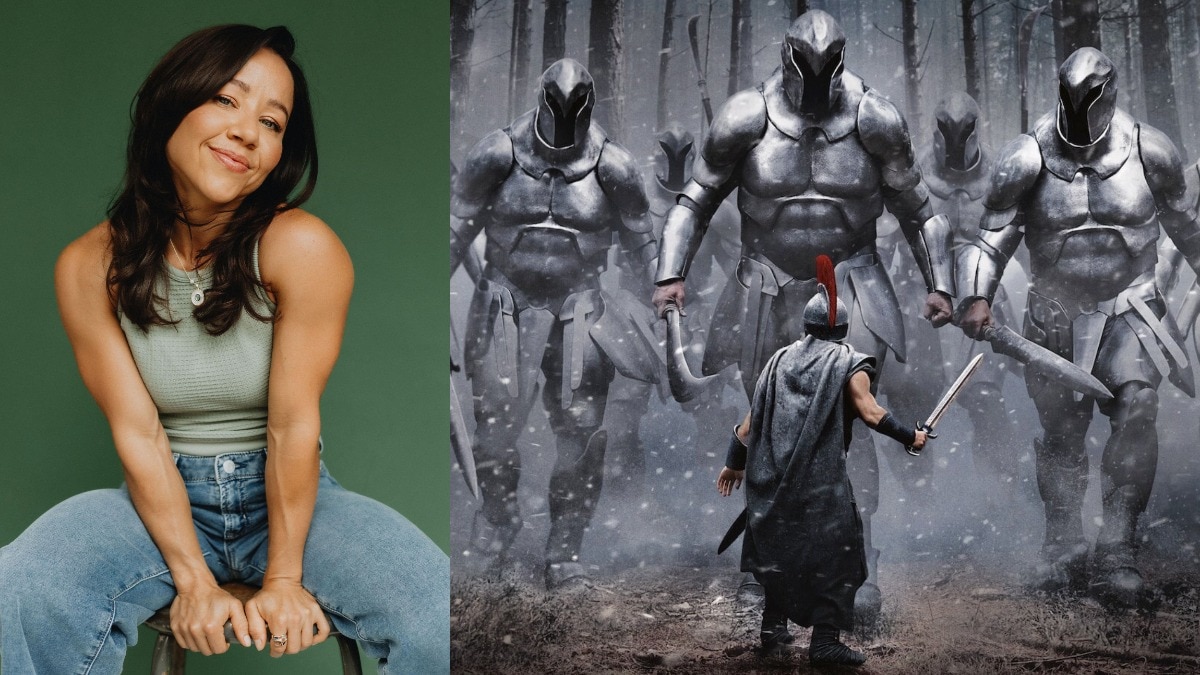
“My double was a woman, a female stunt performer who had the greatest arms I’ve ever seen.”
Yes, Matt Damon was all praise for his stunt performer on The Odyssey during an appearance on the Happy Sad Confused podcast with Josh Horowitz. It was a genuine compliment. But what struck me, and I’m sure many others too, was the fact that he did not end that compliment with “for a woman”. Because isn’t that how it’s always been?
“You’re fast for a woman.” “She’s strong, she lifts like a man.”
The comparison always lingers, setting a low bar long before the compliment even lands. Maybe that’s what made Damon’s reaction feel refreshing. But it wasn’t just him. Fans and viewers all around the world have been praising Canadian stunt performer Devyn Dalton for her recent work, all without reducing the compliment to “for a woman.” What’s great is that she isn’t being measured against other women or treated as an exception to the rule. She’s simply being recognised as exceptionally good at her job. And that’s the real sign of progress: a compliment that doesn’t need a disclaimer.
Part of the fascination came from why Dalton was cast in the first place. Standing at just 4 ft 6 in (around 137 cm), she doubled for Damon during the film’s battle with the towering Laestrygonians, allowing Christopher Nolan to use practical forced perspective instead of relying on CGI to make the mythical giants appear even larger. Damon later revealed that many of the shots where audiences thought they were watching Odysseus dwarfed by the giants, including one of the film’s most talked-about promotional images, were actually Dalton in armour. Once fans realised the figure in that now-viral poster wasn’t Damon at all but his stunt double, the reaction quickly shifted from surprise to admiration for both the filmmaking trick and Dalton’s physical performance.
The invisible qualifier
Now it’s not always about compliments that end with “for a woman”. The qualifier is still always implied. “She knows a lot about football.” “She’s one of the boys.” They think it’s meant to be a compliment, and on the surface it might even seem like one. Still, underneath it, the assumption remains the same: skill, competence, and authority are unexpected traits from a woman.
Today, it’s become so ingrained that we don’t even notice it most of the time. Even if someone doesn’t use the words “for a woman,” the qualifier is already implied. And the way people react, the surprise in their compliment, often acts as a reminder that women are still measured against a different benchmark.
Most of the time, people don’t mean to demean a woman when they add a qualifier to a compliment. And have you noticed how, any time you call out a compliment that felt backhanded, the other person’s immediate response is almost always, “Oh, I didn’t mean it like that,” or “I meant it in a good way.” And they’re probably telling the truth. The intention isn’t usually the problem. It’s the way it was said.
Why did it have to be “for a woman”? Why did her strength have to be compared to a man’s? Why did her humour have to come with an asterisk?
Why it’s not actually a compliment
You’ll rarely hear a woman tell a man, “You’re funny for a guy.” Or, “You’ve got great leadership skills for a man.” Or, “You’re really good with kids... for a man.” Men usually receive straightforward compliments. “He’s strong.” “He’s a great leader.” “He’s funny.” Full stop.
Women, on the other hand, have spent years hearing versions of: “She’s strong for a woman.” “She’s surprisingly good with cars.” “She knows a lot about football.” They sound like compliments, but they all carry the same underlying message: I wasn’t expecting that from someone like you, aka a woman. Compliments like these are often a comparison, and most often, a comparison with men. And that’s the part that needs to go.
Devyn Dalton knows this feeling all too well. Speaking about the response to The Odyssey, she reflected on the challenges women continue to face in the stunt industry, from body image expectations to breaking into a profession that’s long been dominated by men. She was also quick to credit the stuntwomen who came before her for opening doors, while acknowledging that “it’s an ongoing battle.” She said the attention has been especially meaningful because she hopes it encourages young girls to embrace their differences and see strength, not just physical, but personal, as something to celebrate rather than shrink away from.
Maybe that’s why this moment feels bigger than a viral podcast clip. It isn’t that women have suddenly become stronger, funnier, or better at their jobs. It’s that, every so often, the conversation catches up. We stop treating their talent as an exception and start treating it as the standard. And more importantly, when compliments stop carrying invisible footnotes.
Hopefully, one day, “for a woman”, whether spoken out loud or quietly implied, will sound as outdated as it should. Until then, perhaps the best compliment we can give anyone is also the simplest: She’s incredible.
Lead image credit: IMDb
Also read: Is “I’m just a girl” trend really harmless, or are we making female incompetence cute again?
Also read: How cultural conditioning still shapes the timeline women are expected to follow
more from Life

Did Instagram make you eat here?

One of the main 'Bridgerton' cast members is stepping away from the show

The AI ’80s trend is fun, but maybe stop handing over your face to every viral trend
Gen Z is choosing 'soft hermitting' over another night out

Wait, is the side part cool again? Gen Z celebs say yes

Matte meets dewy in a fun move where your makeup doesn’t need to pick sides

Why the planet Mercury is so important to Virgos
What your boyfriend’s algorithm is doing to your relationship
Think sex toys are bad for your sex life? Think again

Plaid is back for fall, and these are the pieces giving the classic print a modern update