The rise of Brotox: Memes about male celebs looking *different* are rife - what's really going on?
More men than ever are undergoing tweakments to either adjust how they look or, in more extreme cases, give themselves a surgical overhaul. Are men now being held up to the same beauty standards the rest of us have been for years? And is this really something to celebrate?
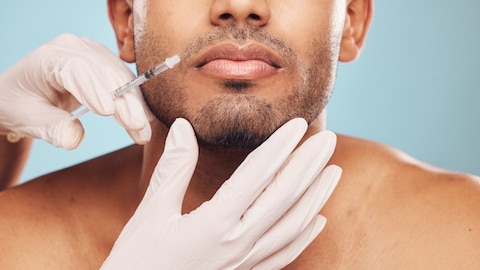
I've never had a guided tour of a face before. But as faces go, Scott's is a very good one. "My chin was squared and made wider," he says, turning his head to show off his profile. Next, he points to his angular cheekbones, not dissimilar to those sported by David Gandy. Here, hyaluronic acid was injected deep into his face using a cannula, on to the bone of his skull itself.
He moves up to his eyes, which were lifted with a finer filler, and finally to the temples, explaining that filler was added to reverse the natural depression there, bringing them to the same width as his cheeks.
Two years ago, for the sum of £1,800, Scott was given a new face. I realise, as I examine him in great detail, that even in the harsh office strip lighting that continually flickers throughout our Zoom call, he looks exceptionally good. I, on the other hand, don't. Scott and I are the same age (43) and, yet, where my forehead is creased with lines, his is smoother than baby's.
I have more laugh lines than the Joker and my skin is pale and uninteresting. Scott doesn't just look younger than me, but healthier, too. Manlier. Better. Have we entered the next era for male grooming? According to Scott, and it'd appear a myriad of other famous male faces (no need to name names, but you'll likely have spotted them on your social feeds... possibly being ridiculed), the answer is yes. And if that is the case, is it about time I whip out my credit card and join them?
Turning point
Growing up in the 1990s, the very idea of male grooming was a (literal) joke. The world guffawed at the very notion of Chandler, Ross and Joey daring to try a face mask in Friends. At the height of the so-called 'meterosexual' revolution in the 2000s, David Beckham was routinely mocked for an endless succession of ponytails, highlights and sarongs, while I was teased by my mates for forking out £50 on a trendy haircut and slapping on some Nivea.
Toxic cisgendered stereotypes of what made a man 'manly' were rife, and the idea that a man might care about his looks or spend time on self-care was berated openly to such an extent it bordered on blatant homophobia.
Today, the popularity of male 'tweakments' is soaring. According to the British Association of Aesthetic Plastic Surgeons, men are queuing up for more cosmetic procedures than ever. Research in 2022 found that men made up 7% of all cosmetic procedures (a rise of 118% from the year prior) –and a number which, as per YouGov, has grown to 11% as of August 2025.
Every sidebar of shame demands to know 'Why does Brad Pitt never seem to age?' and proclaims 'Simon Cowell leaves fans stunned AGAIN with radically different appearance'. Like Cowell, Joe Jonas (at the grand old age of 33) spoke about getting 'him-jectables', saying he wanted to slow down signs of ageing – specifically his frown lines. He told People magazine, "At one point, [people were] like 'Oh, men can't do this or it's weird for guys to do that', and I think there's a stigma that's fading and I like that."
Scott, a video art director from London, had the 'Revolumising and Restructuring Full Face' procedure just after turning 40, at the talented hands of Dr James Olding, a 'cosmetic injector' for the Allergan Medical Institute.
"I was a little nervous," Scott tells me. "That first treatment changed the whole shape of my face. I remember the first time looking at my new face in the mirror. I had a wider chin, a strong jawline, no more sunken cheeks – just a real presence to my face. Initially, I was like 'Okay, that's... different!', but once everything settled down I felt amazing." The thing is, Scott doesn't look like he's been stuck in a wind tunnel. There's no telltale stretched skin. He can smile and frown with ease. And all of these non-invasive treatments were carried out in under an hour.
I'll admit, it's certainly tempting. But what is it the rise in these procedures is telling us? Does the fact men feel more comfortable investing in their appearance mean we're making progress, or is it merely a sign that our culture's unhealthy obsession with the elusive 'perfect' face and body is more prevalent than ever?
A scroll through TikTok seems to prove Joe Jonas's point – the stigma surrounding male procedures is quickly fading. There are more than 17m views of the hashtag 'brotox' alone on the platform, and the resulting feed is full of men getting treatment done. In one video, the TikToker 'xthuyle' explains to her 1 million followers how she persuaded her boyfriend to get work done on his nose. "Couples who get fillers together stay together," she says, just before the first injection slides in.
When I catch up with vlogger Tom Exton and his partner, model Ianthe Rose, they seem to agree with xthuyle. "Tom told me he felt that he looked tired. I asked if he was open to trying [injectables] and suggested my clinician, Dr Sophie Shotter," Ianthe, who has been having treatments since she was 21, says.
Tom was immediately curious. He'd hit his mid-thirties and noticed his wrinkles were getting deeper. And, as a vlogger, appearance is all part of his job. So he took the plunge. "I had a small amount of [facial injections] in the usual places: forehead and crow's feet," he admits. "Nothing major; I don't want it looking like I've had 'work' done. [I've] been having it a couple of years now, every six months or so." Ianthe was thrilled – not just by the results – but by how delighted Tom was afterwards. "If Tom wants treatments, I'm happy to guide him, but I would never push him either way. It's a personal choice," she says. "I think there are many men who would like to get treatments, but they feel it's reserved solely for women.
"I would love for stigma to be broken. If a little treatment here and there helps men feel more confident, I can't see anything wrong with that."
Perhaps the new generation of men, used to filming themselves 24/7, feel more comfortable with artificial improvements? Later, I speak to Josep, a 26-year-old freelance photographer, just as he's jetting off to Paris on a shoot. At his age, many would be surprised that he wants or needs work done, but for him, it was just part of a regular grooming regime. I have two or three top-ups a year at the 111 Harley St clinic. Some people can be judgmental about it, he says.
"They say things like, 'Why do you need treatments. you're so young?' So now I just don't tell anyone. I have quite an expressive face and I was worried I was getting wrinkles on my forehead. I go to the gym, I exercise a lot and I look after my body – so why shouldn't I look after my face, too? I'm single and dating. so first impressions are important. But [facial injections] make me feel more confident, too."
In fact, every clinic spoke to reported an increase in tweakment bookings from men in their twenties and thirties. With his easy manner and soft Cork brogue, Brian Cotter, co-founder of the Sisu Clinic, sounds more like your best mate than a skilled surgeon with international clinics everywhere from Mayfair to New York. "I've been doing this a decade now, and we've definitely seen a massive increase in men coming in, he says. "I saw a paradigm shift about five years ago, driven by the fact we all now have perfect HD cameras in our pockets.
"You can take a great photo, but it's unforgiving on any imperfections on the face. Social media filters can cover it up, make our skin look clear and our faces youthful - but then we want this in real life, too. You don't want to turn up to a date looking 10 years older than your dating app profile pic."
I ask him about the so-called 'Zoom Boom', a meteoric post- pandemic rise in cosmetic procedures, fuelled by a thousand harshly lit video calls across the nation's kitchens a n d spare bedrooms in 2020. Like many of us, my camera was often, 'not working today for some reason, sorry', on mornings when I looked particularly haggard. But I noticed that somehow my female colleagues never looked quite as pale and exhausted as their male counterparts.
Dr Cotter has a theory. "Women were better at coping than men," he says. "Men looked tired online because they had no idea about grooming, whereas some women had the advantage of a better understanding of make-up a n d styling. And that's where we can help. Our male customers don't want t o look radically different; they just want to look at their best. [Facial injections] give them the feeling of wearing a brand-new suit. You walk into the room and look sharper, and you feel good."
Whether make-up really is an 'advantage' for women, or actually a (very tiresome) pressure driven by the patriarchy is. of course, up for debate. But the fact that many men, particularly cis-het men, often don't feel comfortable using short-term make-up methods may explain their preference for the less visible solution of tweakments instead.
I'm considering it, I tell Dr Cotter. Five years ago, I noticed the bags under my eyes didn't disappear after a good night's sleep. Laugh lines and grey hairs began to appear rapidly and I hated them. The sudden decline in my looks made me feel self-conscious and depressed. But the thought of injecting acid into my flesh every three months seemed a dramatic response. I'm not an influencer, a vlogger or an Insta-model, shouldn't I stop sulking and grow old gracefully? Dr Cotter raises an eyebrow.
"Years ago, guys would hide their moisturisers at the back of the bathroom cabinet, ashamed," he says. "But now there are a hundred male products on the shelves. It's normalised. So why shouldn't this extend to cosmetic treatments? At Sisu, we treat everyone from mechanics to men in their fifties who want to look good when they walk their daughters down the aisle to a builder – [one has] been coming in for three or four years and he said to me 'Help! I'm turning into my dad!' It's open to any man from any walk of life, and why shouldn't it be? Men deserve the same opportunities as women to look and feel their best."
But what about the psychological cost of constantly scrutinising my own face? We know we're in the midst of a male mental health crisis, with suicide the biggest killer of men under 50. According to a survey by social enterprise Better, 54% of men show signs of body dysmorphia, compared with 49% of women. So is the injectables boom among men a sign we need to be more worried about what's driving this behaviour? Is it innocent self- care or something more sinister?
Break the mould
Hawaiian print shorts. Glowing teeth. Chiselled cheekbones. Squint and it's hard to tell the difference between the latest men to land on Love Island and the Kens in the Barbie movie. There seems to have been a shift in the past decade or so where the men on our screens have morphed into an almost plastic-looking perfection, with Robert Pattinson recently calling out male beauty standards (albeit referencing body pressures) as 'insidious' and saying Hollywood is 'setting a precedent'.
Yet, there have also been some positives: style-wise, celebrities such as Tan France, Harry Styles and Lil Nas X are all paving the way for a new definition of masculinity and gender expression full stop). And with beauty brands constantly growing their gender-fluid offerings, I'm hopeful the tide is changing. But without this filtering down to the everyday man, we're not there yet.
"What's damaging about shows like Love Island is that the men all tend to look the same: tanned, full head of hair, muscular and young," says Helena Lewis-Smith, a senior research fellow at the University of West England's Centre for Appearance Research. "This portrays the message t o viewers that they need to conform to this narrow ideal to be attractive and successful. The men on these shows take the mick out of each other if they're short or put on weight, and it's labelled 'banter'. But it's harmful and continues to reinforce the importance of appearance. You begin to believe that the more attractive you look, the more value you hold and the more successful you will be."
I know what she means. When dating apps exploded 10 years ago, every online conversation suddenly had to be accompanied by a series of selfies. No longer could I rely on a dodgy chat-up line and the offer of a drink in a crowded nightclub. Now I had to present women with a visual CV of carefully selected photos, plucked from the depths of my camera roll and tuned up with a little, well, Facetune.
The better I looked in the photos, the more matches I got. But then I'd worry that dates would wonder why that guy's older, and slightly hungover, brother had turned up. Back then, if a clever cosmetic clinician had offered to make my real-life face exactly resemble my online one, I would have bitten their surgical-gloved hands off in an instant.
"What's interesting is that our studies have shown that women objectify themselves irrespective of whether they use dating apps, whereas men begin to objectify themselves once they start using dating apps," Dr Lewis-Smith explains. "Women have been under this spotlight for decades, and now men are being asked to meet these unrealistic appearance ideals. Men may finally know what it's like to be scrutinised over their looks, but there are no winners here. We should be embracing and celebrating the fact that we all look different, not trying to all look identical. No gender should have to live up to these unachievable standards. We're simply lining the pockets of the fitness, supplements and cosmetic industries."
In the digital age, men and women might finally be equal on at least one playing field. But do we really want to live in a world where equality just means we're all equally insecure? Towards the end of my chat with Scott, I wonder what made him think about the treatments in the first place. Looking at his 'before' photos, he looks a little softer and thinner in the face. but no one could call him unattractive, I say.
He looks a little sad at the memory. "When I was in my twenties, people would see my gaunt face and ask me, 'Are you okay? Are you sick?' like there was something wrong with me. It might not sound like much, but it would ruin my day. I think they felt it was okay to say that to a man, but it really got to me. I'd look in the mirror and feel bad about myself." Then he smiles to himself for a second . "I remember my partner telling me, 'A fuller face won't make me love you any more or any less'. But for me, it was about self- confidence, about feeling my best self. It's nice to turn up to life looking how you're feeling, you know?
"I'm not interested in competing or comparing myself with others, this is about me. I don't want to look 23, I want to look like a happy, healthy 43-year-old man, and next year I want to look like a happy, healthy 44-year-old man." That's something I can agree with him on. While no amount of hyaluronic acid will make my own insecurities about getting older disappear, that doesn't mean a little 'tweakment' can't help some men find a temporary boost. We all have to find a way to be comfortable in our own skin.
And for now, I'm content enough to look at my slightly saggy, middle-aged face in the mirror for a little while longer.
This article was first published in Cosmopolitan UK's August/September 2023 issue but has been refreshed to reflect the latest data
Credit: Cosmopolitan