Reble with a cause
In the span of a year, the rapper soundtracked three blockbuster movies, graduated college, performed at the inaugural Rolling Loud India, and took home the Cosmopolitan Blogger and Creator Award. For her though, the best is very much yet to come.
May 8, 2026
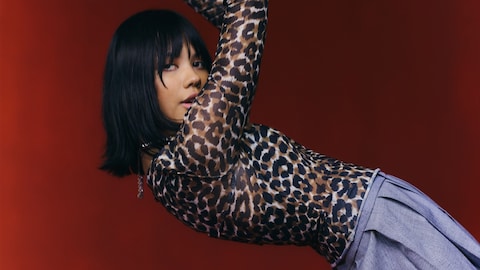
Twenty minutes into our phone call, Reble says, “I am a very boring person.” A ludicrous claim, for she is inarguably one of the most compelling artists in the country right now. But the 24-year-old doubles down: “If people talk to me for the first time, I’m so interesting. The second time too. But the third time they will figure out that I’m actually very, very boring.” How refreshing, to come across a celebrity with no media training. Reble is an anomaly.
Before she was Reble, she was Daya—short of her given name, Daiaphi Lamare, the ‘I’ swapped for a ‘Y’ to make it easier for the non-Khasis to pronounce. Born in Meghalaya’s West Jaintia Hills, Lamare grew up across different parts of the Northeast and spent her prominent years at a boarding school in Shillong. While in school, inspired by artists like Linkin Park, Notorious B.I.G, and Eminem, Lamare started writing songs. It was when she was pursuing a B Tech degree in civil engineering in Bengaluru that she started performing under her stage name, Daya, later becoming Reble (shoutout to her roommate). “I didn’t want my parents to find out that I was doing this [music] on the side, and I always wanted a stage name, too.”
They found out anyway, as parents tend to, after her debut single 'Bad’s' release in 2019. “I was supposed to follow my brother’s footsteps and be an engineer and everything, and I was a promising student too,” Lamare recalls. “So of course they were concerned, like any Indian middle-class parent would be.” But after seeing their daughter hustle for years now, they have made their peace with it. “I’ve not made it, but I’ve made some progress and that’s good enough to show that I can do something, you know?”
Lamare is not one to half-ass things. In college though, she found herself at a crossroads between music and engineering. “I thought I would find a 9-5 job and work on my music on weekends, but I knew I would be compromising on the music.” That was until she got a record deal from Atlantic Records in 2025, right after she graduated. Does she see herself going back to her initial plan now? “Oh, f*ck no. After everything, no, it would not even be amazing,” she says.
A quiet rebellion
Lamare once called her debut EP Entropy (2022) “one of my most terrible works”. Does this brutal honesty make one a better artist, or does it make it almost impossible to finish projects? For the 'Bond Fission' singer, it’s the former. “You have to be hard on yourself. I don’t think being delusional is good,” she says. “I don’t think I’m ever good enough and that pushes me to do better.”
Her latest single New Riot is about embracing chaos and rage as sources of power. “They call me the tyrant, I rule with the violent abuse // They can never clone this, can’t divide it in two.” The official description calls it a declaration against being boxed in or underestimated. The music video has racked up 2.4 million (and counting) views on the artist’s YouTube—her highest yet. Even so, Lamare rarely holds onto the satisfaction for long. “I don’t have a favourite song of mine. I like it, I put it out, and then I just don’t feel the same way anymore because I move on from those emotions and I venture into something else,” she explains.
It’s the kind of behaviour oft associated with artists who intentionally push themselves to the edge. But unlike French author Gustave Flaubert, who famously tortured himself in order to write beautiful things, Lamare doesn’t manufacture her emotions. “I don’t think I deliberately make myself feel these weird, chaotic or intense emotions. I think they just come to me because I am wired that way, and it helps me write.”
To listen to Lamare’s music is to know exactly what she is going through and how angry she is. But it’s not political—it’s more of a personal struggle. “I don’t believe that I can hold my experiences as something to be objectively true for everybody,” she clarifies. “While keeping the rebellious name and sticking to what it suggests, I’m also very calculated with it.”
The controversial blockbuster Dhurandhar (2025) and its sequel Dhurandhar: The Revenge’s (2026) soundtrack catapulted Lamare into limelight. Across the franchise, she voiced seven songs in total: 'Run Down the City – Monica', 'Move – Yeh Ishq Ishq', 'Naal Nachna', 'Vaari Jaavan', 'Aari Aari', 'Main Aur Tu', and 'Rang De Lal (Oye Oye)'. Even though Lamare had an inkling it would be huge, she had never quite anticipated how huge it would actually become. “I looked at it as a commercial project,” she says. “But then it became something I felt was also my own.” Not to mention, Lamare was also featured in 'Thani Lokah Murakkaarithe' for the Malayalam action movie, Lokah Chapter 1: Chandra (2025).
While there are more film numbers on the horizon, Lamare plans on staying true to herself throughout. “I feel like Hannah Montana in the film industry,” she laughs. “Because I’m doing these commercial projects—which I don’t hate—but then I also have my own music which is so different from all of this.”
Lamare knows there is a lot riding on her, as someone from a part of the country, which is often looked at through a myopic lens. She is grateful for the outpouring of love but she wants us to know that she won’t be the only household name from the Northeast. “There'll be more people coming out of my part of the country, and they will be doing a lot more than I am,” she says, and we believe her.
Editor: Snigdha Ahuja (@snigdha.ahuja)
Interview: Ananya Rai (@anniiiiiiiee)
Photographer: Sushant Chhabria (@sushantchhabria)
Stylist: Shweta Sharma (@shwetabetty)
Cover Design: Mandeep Singh Khokhar (@mandy_khokhar19)
Makeup and Hair Artist: Laila Dalal (@lailadalal)
Editorial Coordinator: Shalini Kanojia (@shalinikanojia)
Assistant Stylist: Samya Gupta (@samyaguptaaaa)
On Reble: Mesh top and high-waist pleated mini skirt, ONLY (@onlyindia); jewellery, Bhavya Ramesh (@bhavyarameshjewelry); shoes, The Source (@thesource.bombay)
Read more!