A love letter to florals and the beauty of growing beyond the lines
From the rigid school corridors to the hyper-curated world of Instagram, I found freedom—and fragments of self—in a pattern once dismissed as “too much".
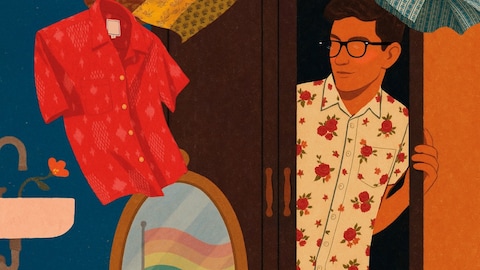
I grew up in a world of starched shirts and straight lines—the kind that didn’t allow much room for colour. At my school in New Delhi, where I spent most of my childhood, discipline wasn’t just a value; it was an aesthetic. Crisp uniforms, buzz cuts, the monotony of beige classrooms—everything whispered conformity. But somewhere beneath the khaki and regulation polish, I was already dreaming in colour. I didn’t know it yet, but my insurgency would one day take the shape of a shirt—bright and unapologetically floral.
At fifteen, I was chubby, reserved, and hungry—not just for food (though the samosas outside the school gate were a daily temptation) but for self-expression. I didn’t have the language yet for who I was—a boy who liked boys—but I knew I wanted to feel beautiful, not just acceptable. And that feeling, that flicker of self-affirmation, arrived one day in the form of an oversized Anokhi shirt I found at their flagship store in Khan Market. It was loose, soft, with hand-blocked flowers bathed in hues of indigo, violet, and sky blue, which seemed to hum under the sunlight. It felt like a secret—my way of saying to the world, “I’m here, even if you don’t see me yet.”
Over the years, that impulse—to find myself in florals—has turned into something deeper, almost ritualistic. My wardrobe today is a garden of its own: Crisp cotton blooms from Fabindia, screen-printed silks from Kardo, a vintage Dries Van Noten ikat number I hunted online, and, when I can afford it, a piece of Prada (the Frankenstein, flowers and thunderbolt prints from creative director Miuccia Prada’s Fall 2019 collection, to be precise)—its brand of intellectual whimsy that turns something as delicate as a flower into an object of power. Dries, of course, is my North Star—a designer who understands that florals aren’t just motifs; they’re mood boards for identity. His Spring/Summer collections have always felt like an ode to flamboyance—patterns that clash until they harmonise, colours that remind you that restraint can be overrated.
Outside the line
It’s funny how something as simple as a shirt can hold so much meaning. Florals have always carried cultural weight—in art, gender, and in politics. Decades ago, a man in a floral shirt was considered too much—too loud, too feminine, too trying. But fashion, in its cyclical defiance, has rewritten that narrative. What was once dismissed as excessive is now a kind of courage. Designers from London and Milan to back home in India have leaned into that duality—treating softness and beauty not as new-age sentimentality, but as a kind of armour.
Maybe that’s why I find floral shirts addictive. They are never neutral; they always say something. Some days they’re armour; some days a love letter to myself. They remind me that masculinity isn’t a uniform; it’s a landscape.
Of course, living in the digital age complicates things. The influx of content—the endless scroll of #OOTDs, trends, and mood boards—often blurs the line between inspiration and imitation. Social media rewards the loudest version of style, the one that photographs well but doesn’t always feel true. I’ve learnt, painfully at times, to separate performance from personality. My floral shirts, though, remain constant. They’re not for the algorithm—they’re for me. They remind me of a time before filters, when style was still tactile, when the feel of cotton on skin mattered more than the number of likes.
Fashion today is all about narrative—who you are, what you believe, and how you want to be seen. And while I no longer crave validation, I do crave authenticity. Florals, for me, have always been that anchor. They’re as much about memory as they are about aesthetics—each print a chapter, each motif a reminder that self-expression is a lifelong negotiation.
I sometimes think back to that teenage boy in his oversized shirt—nervous, uncertain, but constantly learning. He wouldn’t have believed that at 30, I’d still be obsessed with flowers. But maybe that’s the point. Some loves don’t fade, they evolve.
Because at the end of the day, fashion isn’t about trends—it’s about self-expression. It’s how we speak without saying a word. Clothes, after all, are the costumes we wear to create ourselves—in every possible form, and format. And for me, florals are my mother tongue. They’re how I dress, how I feel, and how I communicate to the world—loudly, beautifully, and always, entirely, myself.
Lead image: Illustration by Tanya Chaturvedi
This article first appeared in Cosmopolitan India's November-December 2025 print edition.
Also read: Statement earrings you need to complete your perfect holiday fit
Also read: The curvy girl’s guide to wearing every “scary” trend—and absolutely owning it