Is Gen Z going analogue amid an epidemic of disconnection?
Everyone seems to be online, yet the grid is suddenly very quiet.
I rush back home after school and open Instagram on my iPhone 5. Today is the day when the winner of the Mrs Zayn Malik contest will be announced. (If you were ever a fan of the now washed up British boy band One Direction, you know what I’m talking about. If you don’t, congrats on not having irreparable brain damage). The rules of this competition were simple and harsh: Whoever got the most likes on their selfies—posted across the band’s fan-page accounts, one for each member—would be declared his “wife” and earn the right to look down their noses at everyone who didn’t win. And before you ask, yes, I won. It was not my proudest moment. Or rather, I am not proud to admit that it was a really proud moment.
I was born in 1999 and spent most of my coming of age on the internet. Consequently, I am convinced I have one of the most embarrassing digital footprints under the sun: An Instagram fan page for my high school crush, a Brockhampton stan twitter (I can hear tomatoes being thrown at me), an online boyfriend I never even met. I could go on. But like most people my age, I have lived long enough to leave the cringe behind, that is to say, by deleting everything I could.
If you spend most of your waking time staring at your phone, you would be familiar with countless profiles on Instagram with zero posts. Journalist Kyle Chayka calls this phenomenon “posting zero” in his article ‘Are You Experiencing Posting Ennui?’, for The New Yorker. It’s when “normal people—the unprofessionalized, uncommodified, unrefined masses—stop sharing things on social media as they tire of the noise, the friction, and the exposure.” A survey conducted in 2025 by Morning Consult, an American business intelligence company, found that passive scrolling instead of posting is the norm among Gen Z in the US. The Indian Express also published a story earlier this year arguing that “many young Indians are pulling back from social media, not out of disconnection, but to reclaim control, mental peace, and autonomy.”
With the power vested in me by several hours of posting-deleting-stalking—and, of course, my editor—I asked a group of Gen Z users why they’ve gone MIA after years of posting constantly as though someone, somewhere, was paying them to do so. Nikita Gupta, a 21-year-old zeroposter with a private account, told me that she only ever posts on Stories, and that too when something “cool” happens. “It’s not because I’m shy or anything, it’s more about the micro-level apprehension that comes along with it. Instagram is like the first impression people make of you, and it’s like, ‘Oh, did you see what she posted the other day?’ and things like that. I feel a bit creeped out.”
Problem with being perceived
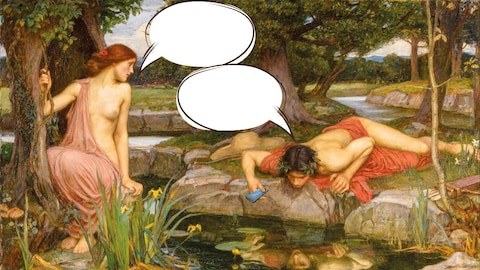
Every one of us has lived through the minor tragedy of posting and immediately regretting it because you looked at that one selfie in slide seven of your photo dump for so long that you morph into an unrecognisable monster. The modern-day Narcissus, if you will. Ishita Mishra, a 22-year-old student at the London College of Fashion, spoke at length about being chronically online, but only as a voyeur.
“As much as we would like to deny it, the Gen Z need to be mysterious and nonchalant, which is why you don’t see anyone posting anymore,” she continues, adding: “Posting too little is not a problem but posting too much definitely is. Why, you ask? Because it makes you look like you’re trying to be an influencer without trying, and that’s not very cool.”
I, too, have zero posts on my Instagram as this story goes to press. That could change tomorrow, because I’m a creature of habit and I like attention from time to time. But for many, there is no crush left to impress and no real incentive to make a post. Alvia Khan, a 26-year-old corporate lawyer is one of them. “I used to post before, but one day it just didn’t feel necessary. I never really figured out why I was posting, and once that urge disappeared, so did the posts,” says Khan. “Honestly, some things don’t need an audience,” she later adds.
For 24-year-old Saanya Chawla, who is an entrepreneur and manages the social media of her brand, posting outfits, outings, and events on her personal account has started to feel cringe and dated. “I have gotten too comfortable with not posting and that has inadvertently turned into a privacy thing,” she shares, adding: “Also, because I manage my business’s Instagram, diving into my personal account feels like a whole other overwhelming task.”
That’s not to say that there are no grid-posters left anymore. For there are more Gen Z influencers now than ever before. But even the ones who post constantly don’t share everything. You might have formed a parasocial relationship with them and feel like you know them, but well, you don’t really. Ilisha Singh Kaurav, a 24-year-old content creator, treats Instagram strictly as work and rarely shares anything deeply personal. “Since my niche is fashion, beauty, and lifestyle, my life naturally becomes part of the content,” she explains, “but the raw and real moments stay on Stories, never the feed. The feed is curated; stories are fleeting and honest,” she adds.
Image: Getty Images (Our rendition of John William Waterhouse’s Echo and Narcissus, 1903)
This article first appeared in the January-February 2026 issue of Cosmopolitan India.
Also read: Confessions of desire: the fantasies people keep off the group chat
Also read: Flamenco guitarist Deepak Verma on falling in love across countries and chasing the perfect note