The great water bottle arms race
Here's how a reusable water bottle became the ultimate wellness accessory and what that says about the way we consume today.
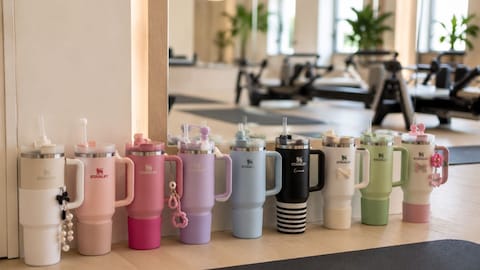
It's 10 am at my Pilates class, and before anyone has rolled out a mat, another ritual is already underway. Along one wall, oversized Stanley tumblers stand in formation. Some wear pastel silicone boots to protect them from scratches. Others have striped sleeves, personalised name tags, bow charms and oversized handles. New seasonal colours are admired, compared and occasionally coveted. One woman has two—one for workouts and another for the office. Another is waiting for a limited-edition drop from the United States. Before the class has even begun, the room has already conducted a quiet inventory of everyone's water bottle.
It is a strangely modern scene. Water has always been essential. The vessel carrying it has never been more expressive. Yet this is rarely about the engineering. Most owners are not discussing insulation technology or stainless-steel construction.
The Stanley tumbler did not invent reusable water bottles, but it transformed them. What was once an entirely functional object became an accessory, a collectable and, increasingly, a marker of identity. The bottle joined the ranks of the handbag, the trainer and the airport carry-on: an everyday object through which people communicate taste, lifestyle and aspiration. Hydration has acquired an aesthetic. Today, it sits comfortably within the modern wellness economy, where every healthy habit arrives with a corresponding product.
The irony, of course, is that water is perhaps the most democratic substance on earth. It emerges from the same tap, regardless of whether it is poured into a ₹500 bottle or a ₹7,000 one. Yet the container has become another way of distinguishing ourselves.
Thorstein Veblen wrote about conspicuous consumption more than a century ago, arguing that people often buy visible goods to communicate status rather than satisfy practical needs. The Stanley phenomenon feels like a distinctly twenty-first-century version of the same instinct. It is conspicuous consumption disguised as sensible living. After all, buying a water bottle appears responsible, environmentally conscious and health-oriented. It doesn't look indulgent in the way a designer handbag might. Yet the social signalling is remarkably similar.
None of this is accidental. Modern consumer culture increasingly relies on turning ordinary objects into emotional purchases. The most successful brands no longer sell products; they sell identities. Stanley sells the image of someone who drinks enough water, attends Pilates, embraces wellness and has impeccable taste while doing all three. The bottle quietly promises discipline, health and belonging.
Social media amplifies the performance. Morning routines begin with someone filling an oversized tumbler with filtered water, adding electrolytes, arranging ice cubes and carefully placing the bottle beside a yoga mat before recording the entire sequence. Hydration becomes content. Wellness becomes theatre.
But every cultural object eventually reaches saturation. Already, competitors are launching their own versions in endless colours and finishes. Accessories multiply. Copycats flourish. Soon, another object will inherit the burden of signalling taste. The water bottle arms race will eventually end.
Until then, tomorrow's 10 am Pilates class will begin the same way it always does. Before the stretches, before the reformers, before the instructor says a word, there will be a quiet moment when a row of carefully accessorised tumblers is placed neatly against the wall.
Everyone will, of course, be carrying water. Not everyone will be carrying the same story.
Also read: If weekends had a dress code, it would be a halter sundress
Also read: The eyelet edit: the prettiest fashion finds about to take over your wish list