The cat dad effect: Why men with cats are winning over the internet
As dating culture shifts away from dominance and emotional detachment, the rise of the “cat dad” reveals why gentleness, caregiving, and emotional safety have become the new markers of modern masculinity.
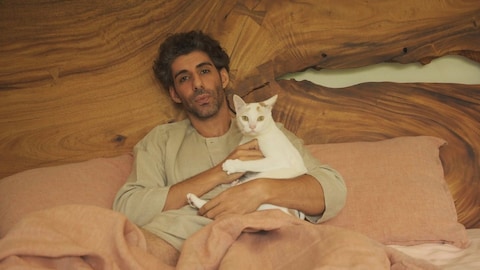
There was a time when dating culture glorified the emotionally unavailable man—the brooding figure who texted rarely, cared selectively, and treated vulnerability like a design flaw. But somewhere between pandemic loneliness, therapy-speak entering mainstream culture, and Instagram feeds full of men cradling rescue cats, a different archetype emerged: the cat dad.
He is gentle. He respects boundaries. He posts blurry photos of a sleepy black cat curled up on his chest. And increasingly, the internet finds him irresistible. But does owning a cat actually signal emotional maturity and caregiving instincts? Or are we simply projecting personality traits onto pets—and the people who love them?
According to Hyderabad-based behaviourist Pranjal Mani Tripathi, the answer lies somewhere between psychology, social conditioning, and modern dating culture's obsession with decoding personality through tiny lifestyle cues. "People absolutely make personality assumptions based on pets," he says. "Even social scientists agree that pet owners tend to have an advantage over non-pet owners when it comes to attracting dating partners."
Tripathi points to the surge of dating-app profiles during the pandemic where men posed with pets—particularly dogs—to signal warmth, care, and emotional accessibility. "People pull wild guesses about personality from pictures," he explains, referring to attribution theory, the psychological tendency to assign character traits based on limited cues. "And attribution does not have to be negative. It can be neutral or positive as well."
According to a 2026 survey by dating app Happn, 44 per cent of Indian singles said pets help start conversations on dates, while nearly one in five admitted to featuring—or considering featuring—pets on their dating profiles to appear more approachable.
Why cats complicate masculinity
Cats occupy a far more complicated cultural space than dogs. "Dogs are often perceived as dependent and submissive, which reflects positively on the owner as a caregiver," Tripathi says. "Cat owners, meanwhile, are sometimes stereotyped as less masculine, less extroverted, or less invested in long-term relationships."
That distinction matters in dating culture. Research, he notes, has found that heterosexual women often rank dog owners as more desirable romantic partners than cat owners not necessarily because of reality, but because of the subconscious associations attached to each animal. Yet despite those stereotypes, the cat dad continues to thrive as an internet archetype, partly because masculinity itself is changing.
Dr Neetu Tiwari, MBBS, MD Psychiatry, and senior resident at NIIMS Medical College & Hospital, Greater Noida, believes the appeal reflects a broader shift away from older masculine ideals rooted in dominance and emotional restraint.
"Traits like gentleness, nurturing, and vulnerability are no longer seen as contradictions to masculinity but as signs of emotional security," she says. "A man who bonds with a cat is often seen as someone who does not need control to feel secure, and that, today, reads as emotional maturity."
The psychology of the cat dad
Psychologically, Tiwari argues, people often read relational qualities into the way someone treats an animal. Cats, unlike dogs, require patience, emotional regulation, attentiveness, and respect for boundaries—qualities that increasingly hold romantic value.
"It is important to note that a cat owner must exhibit patience and respect for boundaries to maintain healthy, loving relationships," Tiwari explains. "Therefore, men who own cats are commonly perceived to demonstrate emotional ability, non-dominating behaviour, and the capacity to create safe, loving relationships."
That perception, experts say, also intersects with attachment psychology. "Cat ownership is often read as a preference for relationships that are respectful, patient, and emotionally grounded," Tiwari says. "With cats, the bond is less about constant reassurance and more about earned closeness, which mirrors healthy human intimacy in many ways."
According to market data platform Statista, India's pet cat population reached nearly 3.6 million in 2023 and is projected to grow significantly by 2028. A separate multi-city Indian study published in Frontiers in Veterinary Science found that 22.7 per cent of respondents reported owning cats, reflecting the growing visibility of feline companionship in urban India.
While India-specific data on "cat dads" and dating culture remains limited, global research suggests the shift is becoming increasingly visible among younger urban generations, including in India, where conversations around masculinity, emotional availability, and caregiving have evolved significantly online since the pandemic.
A 2025 UK survey commissioned by Mars Incorporated found that 36 per cent of male cat owners believed having a cat had improved their dating life, while 30 per cent described "cat dads" as a dating green flag. The study also found that 41 per cent of Gen Z respondents and 40 per cent of millennials considered men who own cats more attractive, particularly when cats appeared in dating-profile pictures.
How social media turned softness into an aesthetic
The cat dad phenomenon continues to thrive online, fuelled heavily by social media aesthetics. Tripathi recalls the viral popularity of Turkish influencer Merayad, whose photos with his black cat attracted enormous female attention online. "People romanticised the idea," he says. "Once that happened, others began following the trend." And social media, he argues, does not merely reflect attraction patterns—it actively shapes them.
Drawing from his background in journalism, Tripathi references the hypodermic needle theory, the idea that media messages directly influence public perception and behaviour. "What media repeatedly shows, people internalise," he explains. "The same thing happened with the cat dad trend."
But Tiwari believes the performative aspect is only one part of the story. "The 'cat dad' image works because it genuinely signals traits that are valued today, like gentleness, emotional safety, patience, and a non-aggressive form of masculinity," she says. "At the same time, social media and dating apps amplify and perform these signals." Still, she argues that performative does not necessarily mean fake.
"Even a simple image with a pet can communicate the ability to care, be patient, and relate without control," she says. "And because cats require building trust slowly, even someone initially drawn to the aesthetic may gradually internalise those caregiving qualities over time."
Caregiving is the new green flag
Behavioural scientist Dr Anindo Bhattacharjee believes our perceptions of pet owners are also deeply tied to longstanding cultural symbolism. "How cat owners are perceived depends on two things," he says. "The cultural connotation attached to cats and the behavioural traits associated with cats themselves."
In some cultures, cats are considered auspicious and intuitive; in others, distant or emotionally detached. Popular media has long feminised feline imagery—from the word "kitten" to broader associations with softness and sensuality—which then extends to men who own cats.
"So men associated with cats are often stereotyped as less alpha or less traditionally masculine," Bhattacharjee explains. But he believes the larger conversation is less about masculinity and more about caregiving. "Having a pet is not just an aesthetic," he says. "It is a responsibility. You feed them, care for them, and clean up after them. Over time, caregiving becomes part of your behavioural pattern."
That, he argues, may be what genuinely attracts people—not the curated image of softness, but evidence of emotional labour and nurturing capacity. "There is a difference between loving and caring," he says. "You may not love someone deeply, but if you are capable of caregiving, that still signals emotional reliability."
Why emotional softness feels so attractive right now
Emotional reliability has become increasingly valuable in a generation exhausted by modern dating uncertainty. "Gen Z is constantly navigating emotional vulnerability," Bhattacharjee says. "Situationships, inconsistent commitment, polyamory—relationships today are much more fluid. In that kind of landscape, people increasingly seek empathy, gentleness, and nurturing behaviour."
Tiwari similarly believes younger generations are prioritising emotional safety over traditional markers of strength. "In the past, existence was dictated by practical survival, so qualities such as strength, endurance, and emotional restraint were prioritised," she says. "But today, people possess more independence and simultaneously more loneliness, burnout, and emotional strain."
As a result, she argues, emotional softness has acquired new romantic value. "People no longer just ask, 'Can this person provide?'" she says. "They ask, 'Can I feel at ease around this person?'" Which is why, experts believe, the cat dad resonates so strongly today. "What people are looking for now," Bhattacharjee says, "is someone who can nurture and care—whether love exists yet or not."
The internet may package the cat dad as an aesthetic. But beneath the memes and viral reels is something more revealing: modern attraction is no longer built solely around dominance or status. Increasingly, it revolves around emotional safety. And few things communicate that faster than a man carefully carrying a cat that trusts him enough to fall asleep in his arms.
Lead image: Jim Sarbh
Also read: The new relationship green flag? A man who is comfortable in the background
Also read: Here’s why men genuinely love going down on women