
Sorry 'The Love Hypothesis' fans, but Dr Adam Carlsen is not exactly a green flag
Adam Carlsen is easy to fall for on screen, but put the romance aside for a second, and there are a few things about him we probably wouldn't be so chill about in real life.

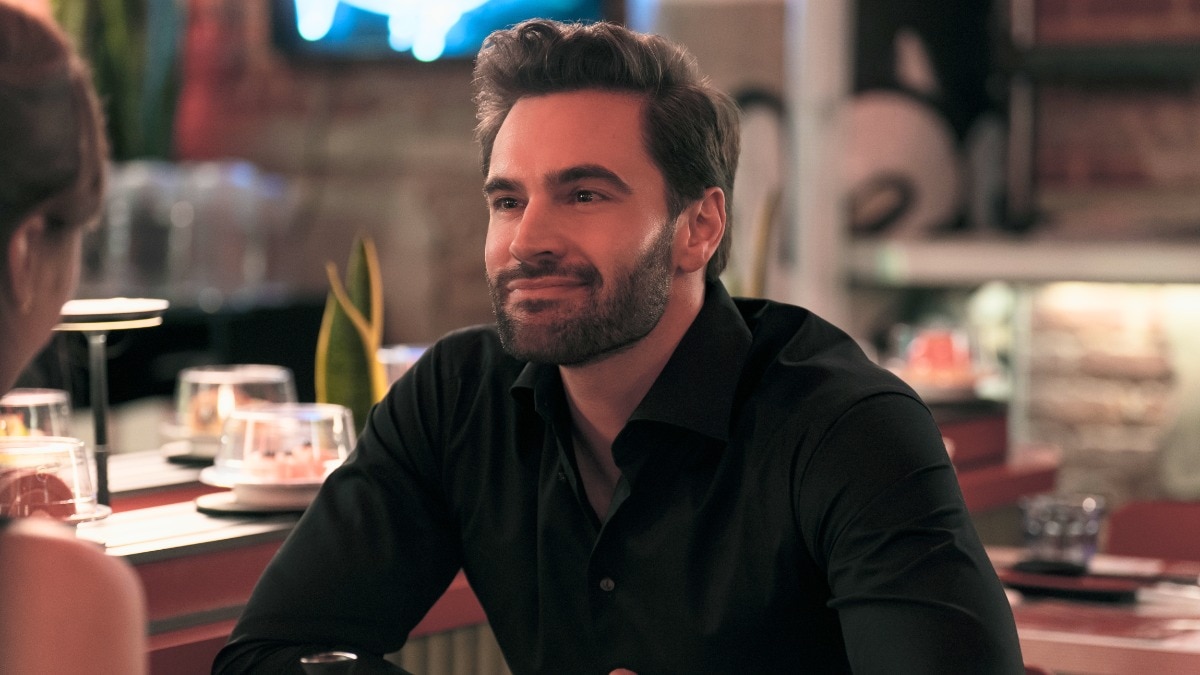
There's a specific version of a fictional man that most people find irresistible. The quiet, intimidating man who is unwittingly rude but also very good at his job, and is apparently incapable of having a normal conversation until he meets a woman he fancies. And Dr Adam Carlsen from The Love Hypothesis is a picture-perfect depiction.
In Ali Hazelwood's book, he is a young, successful Stanford professor with a reputation for being difficult, moody, and brutal with his students, to the point where they sometimes end up having a meltdown in his cabin. Olive Smith knew him as the professor everyone feared long before she knew him as the man she was going to fake-date. The movie, starring Lili Reinhart and Tom Bateman, retains much of that setup, and Bateman's character even has a nickname because of his brooding behaviour: "Dr Evil".
Yet, we can't help but fall for him. Because Adam is also deeply supportive of Olive's work and takes her career seriously. And as the story unfolds, he begins to unveil a much softer side, different from what his reputation suggests. And that's the whole point of his character. The scary professor turns out to be a little more complicated than the rumours about him. The book gives us plenty of moments where Olive gets to discover the kind man behind the one that everyone is terrified of. The movie, on the other hand, leans solely into Bateman's chemistry with Reinhart to make that transformation easier to buy. But take the romance novel out of the equation, and look at Adam as someone you could meet at work, and suddenly many of his supposedly attractive traits look a lot different.
Let's start with the most obvious one. Adam has a reputation for making people nervous, and neither the book nor the movie keeps the reason a secret. Olive has heard stories about Adam's students scraping research projects, postponing thesis defences, and even leaving his lab. The book describes him as mean and hypercritical, someone who seems to believe he is one of the only people doing well in the science department. One could argue that some of this is exaggerated by his reputation.
Olive, of course, doesn't actually know him at this point. And the fact that the Adam everyone talks about is different from the Adam she gets to know is one of the main tropes of the film. He pushes his students because he expects a lot from himself too, and as Olive gets closer to him, she realises that he's not deliberately trying to make people's lives miserable. Still, if a man at your university or workplace has a reputation for terrifying the people who work for him, you wouldn't really think, yes, boyfriend material. You'd probably think, I hope I don't have a meeting with him.
Then there is the way he responds when Olive kisses him. In both the book and film, Adam initially threatens to report her for sexual harassment. In the book, he brings up a Title IX complaint almost immediately after the unexpected kiss. It's played for comedy because Olive is horrified and Adam is being very dry about it, but honestly, it is also one of the few moments where Adam's response feels completely reasonable. After all, she did kiss a stranger without his consent.
Eventually, when their fake relationship becomes a real one, you are expected to accept the academic power dynamic because, well, this is a romance. Olive is a PhD student, while Adam is a professor at Stanford. The book does acknowledge the imbalance, with Hazelwood establishing early on that the two have cleared their fake relationship with the dean and that there is no abuse of power.
The film tries to address the same concern, but its explanation is less convincing. Adam tells Olive that the university is considering scrapping his grant because of his behaviour and reputation among students, as well as his lack of anything tying him to Stanford. His solution is to fake-date Olive to convince the university board that he has a reason to stay, and therefore keep his grant. When Olive questions the idea, Adam explains that he has checked Stanford’s rules and that doctoral students can date postdocs when they work in completely different fields. The problem is that this explanation doesn’t entirely resolve the underlying power dynamic. Adam is still a senior academic figure at the university, and the film never fully clarifies where the professional boundaries begin and end.
That does not make Adam a terrible person, nor does the story treat him that way. In fact, one of the more appealing things about his character is that he takes Olive’s career seriously. When her work is threatened, he supports her rather than asking her to choose between their relationship and her ambitions. But there is still a distinction between a relationship that works within the logic of the story and a relationship dynamic you would necessarily feel comfortable recommending in real life.
And that is probably why Adam works so well as a fictional boyfriend. The story gives us something real life never could: context. We get to see why he is difficult, watch him become vulnerable, hear the conversations that explain his behaviour, and see that he respects Olive’s work and genuinely cares about her. We are never left to guess what is going on underneath the intimidating exterior because the story makes sure we know.
In real life, you would have to figure all of that out yourself. You would not have the internal monologues, carefully timed vulnerable moments, or a narrator reassuring you that the intimidating professor is actually falling for you.
Maybe that is the real trick behind Adam Carlsen. The Love Hypothesis gives us a man with plenty of traits that might raise an eyebrow, then spends the entire story giving us context for them. Once we know he is caring, loyal, and completely gone for Olive, the grumpy exterior stops being a warning sign and starts becoming part of the appeal.
So, is Adam Carlsen a green flag? Not exactly. He is a complicated fictional man who benefits from the fact that we get to watch his best moments, understand his motivations, and see the parts of him that Olive might otherwise have to spend months figuring out.
Would we still watch Olive fall for him? Obviously. Would we tell our friend to date her intimidating professor? Maybe let’s keep that one safely in the fictional world.
Lead image: Prime Video
Also read: 'The Love Hypothesis' and our unending love for the fake dating trope
Also read: Maitreyi Ramakrishnan's 'Best of the Best' is basically every desi girl's college fantasy
more from Life

The restaurants putting India’s regional food on the map

Iced coffee is trying to make it into the job interview but is it actually welcome there?

'Lust Stories 3' has us wondering: Could K-dramas actually ruin your dating life?
'The Love Hypothesis' and our unending love for the fake dating trope

Maitreyi Ramakrishnan's 'Best of the Best' is basically every desi girl's college fantasy

Give your rom-com reads a refresh, and pick up these thriller reads instead

The big-boob tax is real: Why girls with bigger busts often pay more

The biggest hobby trends are all about making something

Is gallic acid the next big thing in brightening skincare?

Are we all relation-shopping without realizing it?