Can't tell your Circe from your Helen? These books will make Nolan's 'The Odyssey' even better
From enchanting goddesses to mythical monsters, these novels shine a spotlight on the characters who deserve their own epic.
Jul 29, 2026
Christopher Nolan’s The Odyssey seems to be everything anyone can talk about right now. From in-depth breakdowns of the director’s retelling of the Greek epic to fan edits of the best moments from the film, my algorithm is completely overflowing. So naturally, I gave in to the hype and watched the movie over the weekend, and let me tell you, calling it a cinematic masterpiece would be an understatement.
While I thoroughly enjoyed every frame, not having read the source material definitely put me at a slight disadvantage. By the end of the movie, I had become that person, relentlessly bugging my friends who had read the books, with questions about scenes and characters who got very little screen time but clearly played a much bigger role in the original story. And I’m sure I wasn’t the only one.
Naturally, my first instinct was to Google every stray thought I had. What was Calypso’s life like before Odysseus washed up on her island? How did Penelope survive those 20 years when Odysseus was at sea? And were the Sirens really as terrifying in the original epic as they looked on screen, or did Nolan take some creative liberties?
Obviously, the film can’t possibly explain every little detail or else, we’d be looking at a five-hour runtime (and even then, it probably wouldn’t be enough). But if, like me, you walked out of the theatre with more questions than answers about the characters who only got a scene or two, these books are the perfect place to dive deeper into their stories.
The Penelopiad by Margaret Atwood
There's no argument that Anne Hathaway did a splendid job as Penelope. But despite being one of the film's main leads, viewers don't really get to experience her storyline or understand what she actually went through during those 20 years spent waiting for Odysseus to come home. Margaret Atwood's novel does exactly that.
A feminist reimagining of Homer's epic, The Penelopiad tells Penelope's story in her own words, narrated from the afterlife. It starts with her childhood and her fraught relationship with her parents, then moves through her marriage to Odysseus and everything that followed while he was away. The most compelling part is that the novella runs a second storyline alongside Penelope's, which is a commentary from the 12 maids Odysseus executed upon his return, who haunt the couple in the afterlife, refusing to let either of them forget what was done to them. If you needed a different lens for those 20 years back home in Ithaca, this is the book to pick up.
Agamemnon by Aeschylus
The film barely touches on what happened to Agamemnon after he made it home from Troy, even though it's one of the more brutal endings in all of Greek mythology. Truth be told, few sources besides Homer's epic explore his story in depth. Aeschylus's play is one of the most reliable accounts, tracing Agamemnon's return from Troy as a conquering hero. Sadly, his welcome is cut tragically short when he is murdered by his wife his wife Clytemnestra, who spent ten years plotting her revenge for his sacrifice of their daughter, Iphigenia, before the war even began.
Fair warning: this one is less about Agamemnon himself and more about the fallout of everything he set in motion, but that's exactly why it earns a spot here. So much of The Odyssey references his death as a cautionary tale, a warning of what could happen to Odysseus if he isn't careful about how he returns home, and this play is the actual source of that fear. It's also the first part of a trilogy, the Oresteia, so if you want to see the whole cycle of revenge play out, this is just where it starts.
Circe by Madeline Miller
One of the characters that left me with more questions than answers was Circe. I was intrigued by her capabilities, how she landed on that island, and even wondered about Odysseus' place in her storyline, which was evidently too brief in the film. In Madeline Miller's novel, readers get Circe's full life story: from her awkward, overlooked childhood as the least impressive of the sun god Helios's children, to her exile on Aeaea after a doomed love affair with the mortal Glaucus gets her banished, to her transformation into the feared sorceress who turns Odysseus's men into pigs.
Miller also covers ground the film skips entirely, including Circe's friendship with Daedalus, her fierce bond with her son Telegonus, and her string of doomed relationships with mortals long before Odysseus ever arrives. By the time she meets him, she's already lived an entire lifetime of heartbreak and power the movie has no room for, including the year-long relationship between them, which is detailed in the novel but never referenced in the movie at all.
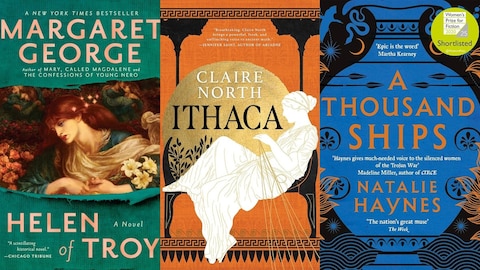
Helen of Troy by Margaret George
Helen is easily one of the most talked about women in Greek mythology, yet the film barely lets her speak for herself. In Nolan's film, she's more of a catalyst for war than an actual character with a point of view. But Margaret George's novel gives her an actual voice, starting with her childhood in Sparta as the daughter of Zeus, her marriage to Menelaus, and the decision (however forced, however willing, depending on the myth you believe) to leave with Paris that's still debated to this day. The book doesn't skip over the aftermath either, from the ten-year siege to her return to Sparta once the war finally ends.
George treats Helen not as a symbol of beauty and blame, but as a woman facing impossible choices under impossible scrutiny, a kind of nuance that the movie just doesn't have time for. If you wanted Helen to feel like more than just a face that launched a thousand ships, this book gets you there.
Ithaca by Claire North
This is another great read alongside The Penelopiad for anyone who wants to know more about what was happening at Ithaca while Odysseus was out fighting monsters and dealing with angry gods. Because someone still has to run Ithaca and keep it from falling apart, and that's a part of the story Nolan's film largely skips over. Narrated by the goddess Hera, Ithaca follows Penelope as she holds Ithaca together while suitors circle, pirates threaten the coast, and everyone around her assumes her husband is dead. She has to walk the impossible political tightrope of playing the grieving widow while quietly outmanoeuvring the men trying to take her throne, never letting them realise she's always one step ahead.
The book also gives Telemachus the space he deserves. Still barely a teenager, he's stuck watching strangers take over his father's home while everyone dismisses him as too young to matter. But instead of making him just Penelope's sidekick, North gives him a proper coming-of-age story, following his frustration, self-doubt, and growing resolve as he figures out what kind of ruler he wants to become without his father there to guide him. Together, Penelope and Telemachus become the reason Ithaca survives long enough for Odysseus to finally come home, making this one of the most satisfying retellings if you wanted more of the story beyond the hero's journey.
A Thousand Ships by Natalie Haynes
The Trojan War is often narrated through the men who fought it, not the people left behind, and very rarely the women who played an important role in it. Natalie Haynes' novel does the latter, jumping between an entire cast of women connected to the war, from Helen, Clytemnestra, and Penelope, to the doomed prophet Cassandra, and even the Amazon queen Penthesilea, who hardly gets a mention anywhere else. Not to mention the enslaved Trojan women, whose entire lives get overturned by a war they had no say in starting. There's also Briseis and the Muse Calliope, who narrates parts of the book while getting visibly annoyed that she's being asked to sing about men again. Who could blame her? A lot of these women only exist in the Odyssey or Iliad as a name mentioned once, a wife left behind, or a casualty of a war fought over someone else's decision. Haynes gives every single one of them an essence that the original epics never bothered to do, which makes it such a gratifying read.
Of course, the novel doesn't completely skip over the men. Menelaus gets his own thread, following him from the moment Helen leaves with Paris through his long, bitter journey home, showing a man far more preoccupied with wounded pride than heartbreak, a different angle than the noble, wronged husband the film hints at.
Waiting for Odysseus by Clemence McLaren
This is another great novel that gives the women in Odysseus's life a voice of their own. McLaren's retelling is interesting because it unveils his journey in four parts, each narrated by a different woman. First Athena, who's been quietly steering Odysseus's fate the whole time; Circe, who gets her own condensed version of the witch-turned-lover arc; Penelope, holding down Ithaca; and Eurycleia, his old nurse, who barely shows up anywhere else on this list despite being one of the only people who recognises Odysseus the second he walks back through the door, scar and all (I'm not talking about the film of course).
One of the great things about this book is that it is technically YA, so it moves fast and doesn't get bogged down explaining every god's backstory. If you're trying to get a quick, readable sense of how all these different women experienced the same story from different vantage points, without picking up four separate 400-page novels, this book does that. And Eurycleia's section alone is worth it, since she's proof that some of the most loyal, important characters in the Odyssey never got a single line of dialogue in the film.
Mythology by Edith Hamilton
The Odyssey throws a lot at you. It doesn't stop to explain every god, monster, or mythological reference, and it's easy to feel like you've missed something. This book fills in those gaps without asking you to commit to another 400-page novel. Unlike the other books on this list, this isn't a retelling at all. It's more like the ultimate Greek mythology handbook, and honestly, it might be the most useful read here. First published in 1942, it breaks down everything from the Olympian gods and legendary heroes to the Trojan War, famous monsters, and the myths that don't always make it into modern retellings. In fact, if you walked out of Nolan's film wanting to know more about Scylla, Charybdis, the Cyclops, the Sirens, or any of the other creatures Odysseus encounters, this is the only book on this list that really dives into their stories and origins in detail. The chapters are short, easy to dip in and out of, and it's remained a classroom favourite for decades for good reason.
All images: Amazon India
Also read: Can we finally stop saying "for a woman" every time we compliment one?
Read more!