Planning your first safari as a couple? Start here
How couples can plan a first safari with intention, from choosing terrain and season to understanding rhythm, ethics and expectation.
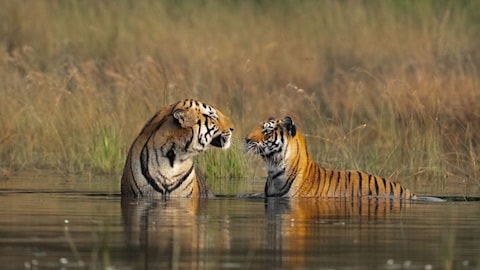
There is a moment just before dawn in the bush when the world feels newly made. The air holds the night’s last cool breath; hooves and paws have written invisible stories across dust. In that suspended light, two people sit side by side, not speaking, watching the land wake. What they feel is older than travel, older even than love: the tremor of belonging.
Wildlife writing has long understood this quiet undoing of the self. “The wilderness holds answers to questions we have not yet learned to ask,” wrote Nancy Newhall, while Peter Matthiessen described the snow leopard’s realm as “a fierce, desolate beauty… where one comes face to face with oneself.” A safari distils that encounter. It pares life to breath, light, distance and presence, and in doing so alters how two people inhabit the same silence.
For couples, a first safari often begins as a spectacle: Amber skies, a tiger crossing, champagne on ice. Yet what endures is subtler, the intimacy of shared attention. The way waiting becomes a form of closeness. The way awe displaces conversation and deepens connection. Planning a first journey into the wild, then, is less about sightings than about shaping conditions for presence. Here is how.
Redefine “once-in-a-lifetime”
For many couples, a first safari begins as a shared fantasy: molten sunsets, cold champagne, a tiger stepping into view with uncanny timing. Beneath it lies a deeper longing for intimacy, the fleeting sense that the wilderness has arranged itself just for two.
Founder of Ameliya Safaris, wildlife filmmaker and presenter Suyash Keshari says, “What they often don't see are the complex permit systems, the seasonal migrations, or the simple truth that the wild does not follow a script. Translating this fantasy into a meaningful itinerary begins with sculpting the right expectations. While we can’t command a wildlife sighting, a well-designed journey ensures the 'magic' still feels inevitable.”
“We do this by moving away from 'checklist' tourism, because probability increases with thoughtful design, not with speed. And thoughtful design is about choosing the right ecosystem at the right time, staying long enough to stop being a visitor and to start feeling the pulse of the land. It’s about the stories told around a campfire by your safari director, and the luxury of time to absorb everything you see,” Kesari tells. Living in cities, we’ve been conditioned to follow a digital clock.
A well-designed safari helps you realise that the only schedule that matters is the rising sun or the alarm call of a deer. You don’t just watch nature; you remember that you are a part of it. That is the real once-in-a-lifetime feeling.
Choose by personality, not passport
The most defining element of a safari is rarely geography; it is temperament. How a couple wishes to encounter the wild shapes everything that follows.
Some couples yearn for immersion in its most elemental form: Long tracking drives, walking safaris, raw terrain and the quiet exhilaration of physical effort. “Are they seeking the adventure of a lifetime together—with extended drives, active tracking and the rugged intimacy of the wild? Or a slower, wilder ease—shorter drives rich with storytelling, private vehicles and bush sundowners, followed by afternoon massages and dinners by the pool?” Keshari reflects.
He remembers guiding a couple who chose to spend their anniversary tracking snow leopards in Ladakh—sub-zero air, a homemade cake shared at altitude, and, through the scope, the fleeting grace of a mother and cub. “But I know of couples who would much rather celebrate this occasion gliding along the waterways of the Okavango Delta, or enjoying the culture and luxury amidst Jawai’s leopard hills. The best safari isn’t country-led- it’s personality-led,” he adds.
Understand seasonality beyond sightings
Season in the wild alters not only movement but mood. Peak months bring clarity: animals gather near water, vegetation recedes, and sightings become more certain, along with cost and company. For devoted wildlife travellers, the density can feel exhilarating.
Green or shoulder seasons hold a different seduction. Forests deepen into lushness, rain scents the air, and animals move through layered cover. Sightings demand patience, yet arrive with heightened drama, a silhouette through wet grass, a cat against dark rock. “It becomes more intimate,” Keshari says. “You trade predictability for atmosphere.”
The choice is less practical than emotional: certainty or enchantment.
Prepare for the rhythm of safari life
Safari days unfold to an ancient cadence. A soft knock before dawn. Coffee in darkness. Departure as the world exhales cool air, and animals are still moving. In India, morning drives stretch long, sometimes with breakfast laid beneath a tree. Heat gathers by noon; stillness follows. Then, as light softens, motion returns.
“It’s immersive, sensory, and physically demanding. You wake with the birds and sleep with the stars," Keshari explains. There’s dust on your skin. Wind in your face. Long stretches of silence punctuated by sudden adrenaline, but the most underestimated part of the journey is the emotional unpredictability: Not every drive is cinematic. “But sometimes, a single 30-second moment changes everything. I always recommend my guests to be prepared for this, and many couples tell me that experiencing these highs and lows together, away from digital distractions, is unexpectedly transformative,” says Keshari.
Respect the logistics. They make the magic possible
First-time travellers often discover that safari luxury begins with gentle constraint. “You might be staying in a world-class tented suite in Africa, but you are restricted to a 15kg soft-sided duffel bag for bush flights. It’s a practical necessity for most aircraft, and a beautiful lesson in minimalism for the travellers,” Keshari says.
Then there are the Conservation Levies. “I want guests to view these not as 'fees,' but as their direct footprint in the sand. Every dollar goes toward the rangers and the anti-poaching units that make these sightings possible. You aren't just a traveller; you are a patron of the ecosystem,” Keshari explains. Embracing these logistical 'quirks' is part of the initiation into the safari lifestyle.
Lastly, and most importantly, a reality that surprises most people is how far in advance planning needs to begin. Keshari says, “In Indian National Parks such as Bandhavgarh and Ranthambore, safari permits are government-regulated and released months ahead. Prime zones sell out up to 4 months in advance. In Africa, depending on the season, the best camps can sell out up to a year in advance.”
These logistical realities may not sound the most romantic, but thoughtful pre-planning is exactly what makes the on-ground experience feel more magical for first-time travellers.
Make impact part of the itinerary
A safari is, at heart, a privilege, and its ethics rest with the operator. Promises of guaranteed sightings often signal compromised boundaries. Responsible safaris prioritise animal welfare and conservation over spectacle and optics.
True sustainability reveals itself in depth: transparent funding, habitat restoration and meaningful community employment. “In the wilderness, luxury and responsibility have to coexist,” Keshari says.
When they do, travellers move beyond observation into quiet stewardship, helping sustain the landscapes they came to love.
Image: Suyash Keshari, Ameliya Safaris
Also read: Too stressed to switch off? The Japanese ofuro bath might be the evening reset you need
Also read: “I tried ‘forest bathing’ to cure my neurodivergent burnout – here’s my honest review”