Why Gen Z actually likes standing in queues now
In an age of instant delivery and on-demand everything, Gen Z is choosing to wait, turning the queue into a test of desire, a badge of belonging, and a surprisingly potent form of social currency.
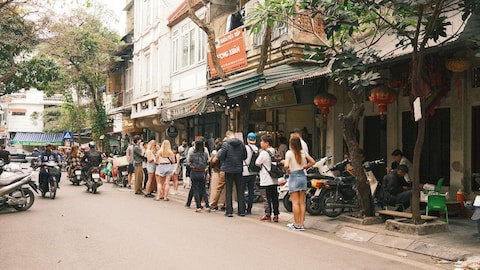
Benne, the tiny outlet that opened in GK2’s M Block Market on New Year’s Eve, is little more than a hole in the wall with a tawa attached, serving a dosa so drenched in butter it should probably come with a cardiology disclaimer. By 8am, the queue outside rivals a passport office—or a liquor shop before a dry day. Nobody here is being detained. There’s no flight to catch, no file pending since April. Every person in that line has, that morning, chosen a plate of dosa over their bed, their food delivery app and several decades of hard-won Indian convenience. This is a generation raised on 15-minute delivery, willingly unlearning all of it in a weekend.
Delhi, being Delhi, didn’t stop at dosa. AlienKind, a Bengaluru import selling UFO-shaped sealed burgers, now has its own respectable queue in Connaught Place. And when Swatch and Audemars Piguet dropped their "Royal Pop" collaboration in May, the crowd outside the Mumbai store got so unruly that the mall simply refused to open the shutters. Watches or no watches.
There’s something about seeing 40 people willing to wait for the same thing that does something to the brain no review quite can. Suddenly, the butter, burger or piece of Swiss ceramic isn’t just a product—it’s proof. By the time you get your hands on it, it has already tasted, or ticked, excellent several times over in your head. "I waited three hours for this" was never really a complaint—it’s a trophy wearing an inconvenience as a disguise. And somewhere around hour two, leaving starts to feel like admitting those first two hours were wasted. No self-respecting Indian is doing that.
Delhi-based sociologist Sangita explains that Indians have always queued for railway counters, cinema halls, ration shops and, later, limited-edition sneakers and store openings. But the old queue was transactional: you waited because there was no alternative. Today, the wait itself has become part of the spectacle. Social media turns long queues into public proof of desire, access and belonging. Instagram didn’t invent the Indian instinct to wait; it simply gave the queue better lighting, a location tag and a hashtag, turning a means to an end into a status symbol.
When waiting makes something look better
Seeing dozens or even hundreds of people waiting for something creates an immediate assumption: there must be a reason. And when we don’t have the means to objectively judge whether something is actually worth the hype, other people’s behaviour becomes information.
Dr Neetu Tiwari, a psychiatrist from Noida, says, "Scarcity amplifies the effect. When something feels inaccessible, exclusive or difficult to obtain, the brain can associate that difficulty with higher value. The queue therefore becomes more than an inconvenience; it becomes a visible sign of demand, exclusivity, and social importance." There’s also an element of FOMO at play: when everyone else seems to be doing something, we don’t want to be the one person who missed it.
But writing all of this off as herd behaviour is too easy. Tiwari says, "A queue can generate curiosity and anticipation about the cultural experience that is about to unfold. Sometimes, the difficulty involved in getting something can make the eventual experience feel even more valuable. In that sense, the queue itself becomes part of the process through which a product or experience gains popularity and perceived value."
Choosing to wait changes everything
Voluntary waiting feels fundamentally different from being forced to wait because choice changes our perception of time. When you choose to stand in a line, you’ve already decided that whatever is waiting at the other end is worth it. The same three hours can therefore feel less frustrating, and strangely more rewarding, when you’ve chosen to spend them chasing something you want.
"Anticipation plays a major role, too. When we expect something we want, the reward begins before we actually receive it. Curiosity builds. Emotional expectations build. And sometimes, people value the eventual reward more because of the effort they invested in getting there," explains Tiwari.
This is particularly interesting when it comes to Gen Z, a generation raised on instant delivery, streaming and everything-on-demand. So much of everyday life now arrives almost immediately. But that doesn’t necessarily mean they’ve rejected waiting altogether. Instead, they may be choosing the rare situations where waiting becomes part of the fun—a deliberate decision to spend time on something that feels valuable, unique or culturally significant.
When the queue becomes social currency
Sometimes, the queue itself becomes the flex. Saying "I waited three hours for this" or posting from a sold-out event turns the struggle to get there into social currency.
Tiwari points to the effort justification effect, where people may place greater value on something they’ve had to work harder to obtain. The longer the wait and the harder the access, the stronger the feeling of "I earned this."
Social media adds another layer. Posting from a sold-out event, a pop-up shop or an impossibly long queue can signal cultural awareness and inclusion: I was there. I knew about this. I got in.
For some people, that reinforcement becomes part of the attraction. But assuming everyone in a queue is chasing status misses the point. It can be a messy combination of genuine interest, FOMO, anticipation, social inclusion and the satisfaction of finally getting access to something you wanted.
There is, however, another player in this psychology: the business on the other side of the queue.
Puneet Chhabra, business head at Leads Brand Connect Pvt Ltd and India partner for plant-based food brand Amazonika Mundi, sees the queue not simply as an accidental consequence of popularity but as a form of leverage for restaurants and food businesses. "The queue is primarily a psychological tool used by restaurant owners and celebrity chefs," he says.
According to Chhabra, it works through three interconnected ideas: perceived exclusivity, anticipation and social proof. Making something difficult to access can make it feel more desirable; the time spent waiting builds anticipation; and seeing other people in the queue becomes evidence that the experience is worth having.
That matters even more for new restaurants that don’t have decades of reputation behind them. A legendary chole bhature joint can point to years of accumulated trust. A newly opened dosa counter has no such history. For the newcomer, a visible queue can become an early form of social proof—a public demonstration that people are willing to give the place their time.
But Chhabra draws a sharp distinction between an organic queue and a manufactured one. "I would distinguish between an organic queue and a manufactured one," he says, referring to the practice of creating the appearance of demand through decoy queues. The problem, he argues, isn’t simply that these tactics can mislead customers; they can also become commercially unsustainable. A queue that looks impressive from the outside but doesn’t translate into repeat customers, loyalty and revenue eventually becomes an expensive performance.
The strange little community of a queue
There is something unexpectedly intimate about standing beside strangers who have all shown up for exactly the same reason.
Tiwari says, "Queuing can create a temporary sense of community, identity, belonging and togetherness. Having a common goal gives people something to share, something to look forward to and something to participate in. Suddenly, there is a quiet sense that we are all here for the same reason."
For Gen Z, this is particularly interesting because so much social interaction happens digitally. A queue creates room for spontaneous conversations, reactions and face-to-face interactions that simply can’t be replicated online. Waiting time can become part of the experience rather than just an inconvenience.
Tiwari adds, "There is also the energy of collective anticipation. Watching other people get excited, talk about the event or react to what is happening around them can heighten one's own excitement. People begin to feel that they are not merely observing an experience but participating in a cultural moment."
Of course, not everyone standing in a queue is looking for a new community. Sometimes you just really want the dosa. But when something is especially popular, a concert, pop-up, restaurant or cultural event, the queue can offer something beyond access. For a little while, it gives you the feeling that you’re part of something everyone else seems to know about too.
And perhaps that’s why the queue has become so powerful. We used to wait because we had to. Now, increasingly, we wait because everyone else is waiting, and because, by the time we get to the front, the thing we wanted has become about much more than the thing itself.
Image credits: Pexels
Also read: Time is luxury. Youth wants in.
Also read: ‘Bed rotting is my only peace’: Is giving up the secret to happiness?