What’s my age again? When did everyone start looking 25, and why?
I asked two aesthetics experts to weigh in.
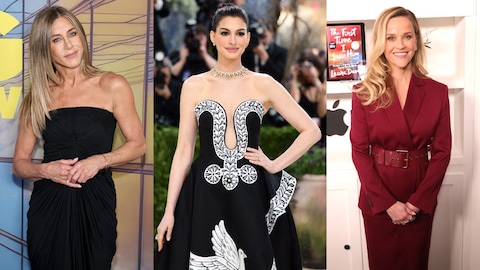
In the midst of The Devil Wears Prada 2 mania, the internet is both baffled by and in awe of millennial queen Anne Hathaway. Forget the film’s plot—my focus (and the majority of the internet’s)—has been on Anne’s apparent vampire status as she seemingly hasn’t aged a day since The Devil Wears Prada first debuted 20 years ago.
And it’s not just Anne. A growing number of A-list celebrities appear to be aging backward—or not aging at all. Poreless Margot Robbie, 35, recently played teenage Cathy in Wuthering Heights. Then there’s Kris Jenner, 70, who on some days looks like she could pass for Kim’s sister.
This illusion, if you will, is part of a broader cultural shift around aging that’s been playfully dubbed “age blindness.” The catchy term, coined by TikTokers, refers to the increasing difficulty in discerning someone’s biological age. In a culture where filters, skincare, and cosmetic procedures are widely accessible, the visual markers that once signaled someone was in their 30s, 40s, or beyond have all but disappeared. The result is a kind of collective age dysmorphia, where no one quite knows what any age is supposed to look like anymore—including their own.
Hollywood plays a significant role in reinforcing this phenomenon, normalizing plastic surgery and cosmetic enhancements while also relying on flattering angles, lighting, and post-production editing. Images of celebrities who appear objectively younger than their chronological ages, combined with highly curated social media feeds, have fueled a growing desire for both surgical and nonsurgical aesthetic procedures—demand that continues to rise year after year.
“Age blindness is a positive feedback loop,” says Michael J. Stein, MD, a double-board-certified plastic surgeon based in NYC. “There is a lack of acceptance for aging, leading to more people getting plastic surgery, and with more people looking younger, others feel the pressure to look like what they think is the new ‘age appropriate,’” he says.
Adding to the age confusion, everyone’s timeline for engaging in these maintenance treatments is increasingly nonlinear. Many are opting for procedures like “baby Botox” or mini lifts before the first visible sign of a line or sagging appears. And then there are the highly curated personal brands influencers perpetuate across our feeds. I can’t be the only one whose algorithm is filled with GRWMs, documented aesthetic treatments, Pilates workouts, and shopping sprees—content that normalizes constant maintenance and elevates the standard of beauty in a way that makes it feel increasingly hard to keep up. With each treatment or procedure, we’re not only looking younger but arriving at the same aesthetic ideal.
And then there’s our collective skincare obsession. From multistep self-care routines to trends like looksmaxxing and its many offshoots, the way we care for our skin and bodies today reflects what Shereen Teymour, DO, a board-certified dermatologist in New York City, calls “skin literacy”—and it’s undoubtedly a major contributor to our collective age blindness. Many of us now understand concepts like collagen loss, UV damage, pigmentation, and inflammation in ways previous generations simply didn’t.
“Millennials were the first generation to normalize preventative aesthetics—daily SPF, prescription retinoids in our 20s, neuromodulators before deep static lines set in, energy-based devices for collagen support. So when people say, ‘You don’t look 35,’ what they often mean is, ‘You don’t look like what 35 used to look like,’” says Dr. Teymour. The improvement in skin quality, for instance, is what really creates that “years younger” effect and drives the idea of age blindness, she adds.
The millennial aesthetics obsession doesn’t come without a cost, both literally and figuratively. Millennials spend more money on products and procedures than any other age bracket—and 40 percent have regretted overspending on cosmetics. When I talk to friends, almost all of them say that they feel some degree of societal pressure to use anti-aging skincare products and undergo treatments like fillers and Botox.
Add to the mix the life milestones we’ve long been conditioned to associate with getting older. Traditionally, your late 20s and 30s come with certain markers—career stability, marriage, kids, homeownership, the idea of “settling down.” But when those milestones don’t happen on that expected timeline, whether by circumstance or by choice, your psyche may not receive the cues it once associated with aging, creating yet another layer of age blindness.
“The issue is that the body and calendar keep progressing even when milestones don’t, and it’s in that space—between where you feel old or young and where you are chronologically—that age blindness or dysmorphia exists,” says Sanam Hafeez, MD, a New York City-based neuropsychologist and director of Comprehend the Mind. “Not as a delusion but as an objectively confusing discrepancy your brain is trying to reconcile.”
As the old, if misattributed, saying goes, “Youth is wasted on the young.” In that spirit, is there really anything wrong with perceiving ourselves as looking and feeling younger than our biological age? According to Dr. Stein, making changes to your physical appearance can boost confidence, reduce anxiety and depression, encourage social interaction, and even inspire more physical activity. Those lifestyle shifts, he says, can positively impact both health and appearance and, in a sense, “turn back the clock.”
The idea of turning “back the clock” is inherently ageist. But the goal, experts say, shouldn’t be to erase age but to optimize how you age. “Healthy skin at 40 looks different than healthy skin at 25, and that’s okay,” says Dr. Teymour. “If someone feels vibrant and aligned with how they look, that confidence is meaningful.” The key is maintaining perspective and prioritizing mental wellness alongside cosmetic goals.
“The healthiest reframe isn’t ‘age doesn’t matter,’ because it does—it shapes you,” says Dr. Hafeez. “The healthiest reframe is ‘my age doesn’t have the right to tell me who I’m allowed to be.’ There’s a big difference between those two, and learning to live in that distinction—honoring your experience without being imprisoned by your number—is some of the most important psychological work a person can do.”
Aging is inevitable, but how we experience and perceive it is evolving. “That evolution is not inherently negative,” says Dr. Teymour. “It just needs to be grounded in science, balance, and self-awareness.”
Credit: Cosmopolitan