Gen Z is bringing made-to-measure fashion back and making it cooler than ever
With tailors on speed dial and individuality front of mind, Gen Z is bringing made-to-measure back into the spotlight—joined by celebrities and stylists who are redefining designer fashion for an Instagram-first world.
Apr 11, 2026
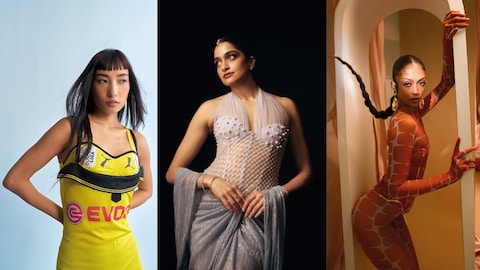
There was a time when the ultimate fashion flex was saying, “It’s vintage.” Today, it’s something else entirely. It’s when someone leans across a table, looks at your outfit, and asks, “Where is that from?” And, the answer is: “It’s custom.” Not because it’s couture in the traditional sense. Not because it took six months and a Paris atelier to produce. But, because it exists only once.
In the era of next-day delivery, TikTok micro-trends, and algorithm-fed wardrobes that start to feel eerily identical, Gen Z has decided that originality isn’t something you buy—it’s something you build. Scroll through any social media feed and you’ll notice it. A thrifted blazer often sits over a corset, a vintage sari may be reimagined as a skirt, or you might even spot a Loewe-inspired silhouette recreated by a local tailor in Bandra, Mumbai. Vintage metals, DIY embellishments, and visible seams make cameos as well. Maybe even a Galliano-era belt paired with something you got stitched last week.
Tailoring has never been niche in India; it is an inherent part of our lives, with most of us having grown up watching fabric transform on a whirring machine in a cramped shop. So, what Gen Z is doing isn’t inventing something new—it’s reframing something familiar.
Alongside thrifting, upcycling, and maximalist layering, customisation has emerged as one of the defining fashion behaviours of the generation. In a world that flits from one fickle micro-trend to another (we don’t need another polka-dotted tank top revival), Gen Z has realised something crucial: If everyone can buy the same thing, the real luxury lies in making your own pieces.
You can see this shift playing out directly in tailoring shops as well. Mumbai-based tailor Ramesh Patel, who runs a small workshop in Bandra, says younger clients are walking in with far more specific ideas than before. “Earlier, people would bring a catalogue picture and ask us to copy it exactly,” he says, adding: “Now, they come with screenshots, research, and even their own sketches. They want to change the sleeve, the neckline, the length: They want something that feels like their own design.” For many such tailors, the change is noticeable—not just in what people want stitched, but in how involved they are in the design process.
And the movement isn’t limited to fashion capitals either. From Surat and Indore to Kochi, creators and young shoppers are increasingly turning to neighbourhood tailors and small boutiques to recreate runway references, experiment with silhouettes, and make everyday dressing feel more personal.
Cart is out, a dart is in
Across global fashion, we’re seeing a move away from predictable brand dressing towards narrative dressing. Actor Zendaya has been mixing heritage maisons with emerging designers. Singer Dua Lipa regularly features niche labels alongside archival pieces. Closer home, models and fashion creators like Nancy Tyagi, Subiksha Shivakumar, and Prerna Massey are increasingly pairing wardrobe staples with made-to-measure pieces from smaller Indian ateliers. Love her or not, even creator-actor Uorfi Javed has built an entire fashion identity around creating experimental looks from her bedroom.
With influencer storefronts and AI-powered recommendations taking over, custom clothing feels almost rebellious. For designer Shubhika Sharma Karia, founder of fashion brand Papa Don’t Preach, this instinct feels familiar. “When I started Papa Don’t Preach, it functioned very much like an intimate studio space,” she says. Clients would walk in not just with references but with memories, turning the garment into what she describes as “a collaborative canvas.” That mindset is resurfacing today, but with a new generation at the helm. “Gen Z approaches fashion with a heightened sense of identity,” she notes, adding: “They’re not dressing to blend in, they’re dressing to articulate who they are.”
The Pinterest-to-masterji story
The idea rarely begins in ateliers—more often than not, it shapes in saved folders on Pinterest. Runway references from designer-couturiers like Dilara Findikoglu or Schiaparelli are increasingly making their way not into shopping carts but into conversations with the tailors.
Fashion content creator and winner of Breakout Model of the Year at Cosmopolitan Blogger & Creator Awards ’25–’26, Subiksha Shivakumar reflects on this shift. “I like expressing myself through my fashion and makeup,” she says simply. Within her community, she has noticed more experimentation—from upcycling to wearing outfits “the wrong way”— driven by a desire to not look like everyone else. When everyone has access to the same trends and the same fast fashion retailers across India, differentiation is the only form of self-expression.
Designers working with upcycled and reimagined garments are also noticing a shift in what consumers are placing value on. Delhi-based Ustat Kharbanda, founder of fashion label Duja that works with upcycling, sees custom and limited pieces as a way to move away from waste.
Working with existing garments, surplus fabrics, and heirloom textiles means responding to what already exists rather than starting from scratch. The result is often visible irregularity. Patchwork. Repairs. Asymmetry. And Gen Z can’t get enough of it. What once would have been called “unfinished” now reads as deliberate. The raw hem is no longer a flaw, it’s proof of process. “Younger consumers are far more open to pieces that don’t fit the traditional idea of ‘perfect’,” Kharbanda explains.
The boutique renaissance
Beyond individual tailoring, boutique ateliers are also experiencing renewed relevance. Mumbai-based designer Tianna Khambatta’s journey began in a home shaped by in-house seamstresses—her grandmothers— who helped bring early design ideas to life. “If I couldn’t find something that felt like me, I created it,” she says. Today, her atelier operates less like a traditional fashion house and more like a collaborative space. “Everything is adapted to the client,” she explains. Pieces transformed from heirloom textiles or family garments, she notes, carry “history, emotion, and meaning that you simply can’t replicate with ready-to-wear.”
This shift is also reshaping the styling process. Celebrity stylist Garima Garg sees custom pieces as contemporary tools of expression. “Ready-to-wear is easy. But custom is personal,” she adds. When silhouettes are built for a specific body and presence, she adds, they carry an intention that off-the- rack pieces just can’t replicate: “There’s nothing more exciting than when something feels ‘built’ rather than ‘bought’.” Garg often works closely with designers like Surya Sarkar, Shruti Agarwal (Studio Picante), and Khambatta to bring her original vision to life.
The slow burn
Of course, customisation and tailoring demand patience. In a world where creativity is being programmed to work on autopilot, the human touch carries new weight. As Artificial Intelligence adds ‘stylist’ and ‘trend analyst’ to its resume, sitting down with a tailor, negotiating a neckline, adjusting a sleeve, and debating fabric feels intimate. For many, the pay-off is the emotional connection. “Of course it takes more time,” Shivakumar admits, “But the results make it worthwhile.”
Taken together, these shifts suggest something larger than a transient trend. Sharma sees the surge of collaborative fashion as part of a broader recalibration. “Bespoke feels far more democratic today,” she says. For a generation raised on mass production, the ultimate luxury might no longer be speed, but specificity. Not something trending. Something tailored. Not something everyone can link. Something no one else can replicate.
All images: Respective brands
This article originally appeared in Cosmopolitan India's March-April 2026 print issue.
Also read: Fashion’s boldest accessory right now might just be a sex toy
Also read: Alia Bhatt says "being original is messy and imperfect", and honestly, it makes so much sense
Read more!