‘I’ve caught hundreds of men cheating’: TikTok’s honey trappers on how they know if someone is playing around
Garnering millions of views, cheating content has taken over TikTok. But is our obsession with infidelity warping our reality?
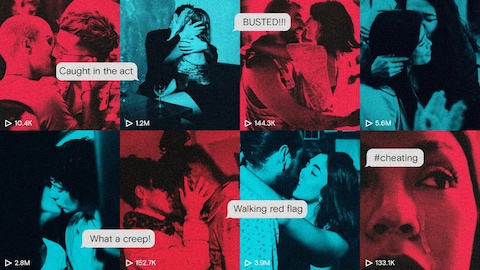
‘I am not usually the type to DM someone out of the blue, but you’re sooo hot,’ Madeline taps out. She’s fully scoped out this guy’s profile: photos of him out with the boys? Check. Selfies in the gym mirror? Check. A potential other half splashed across his page? Nowhere to be seen — the only girl in photos with him is his sister. On the face of it, it looks like her target is single. Instagram DM slides are a common occurrence in dating nowadays, so she goes for it, wondering if he’ll take the bait...
Fast-forward a few hours (and flirty exchanges) later, and Madeline has exactly what she came for. The man has invited her out for drinks, even suggesting to ‘see where the night takes us’. But the truth is she has no intention of going on a date with him. Instead, she screenshots the entire conversation — and the unsolicited photos he sent over — and sends them to his wife, who she’s been talking to for days. She promptly blocks him, and, with his wife’s permission, exposes him to her 159k TikTok followers.
The sun is out, and the girl that’s popped up on your feed is loving it. With her cat-eye sunglasses on and her plastic glass of wine in hand, she’s dancing in a crowd, smiling into her front-facing camera as dance music blares in the background. It seems like this is a standard ‘look how much fun I’m having at a festival!’-style post, but then you read the words plastered on top of it. ‘If this is ur boyfriend at Tomorrowland VIP, he was making out with my gf for 20 minutes and then when she asked for his Instagram, he said no because he has a gf but it’s okay because ‘it’s Tomorrowland’.’ It tums out we’re not meant to be looking at the girl (the creator of the video), we’re supposed to be looking at the man behind her, sunglasses planted firmly on his head, sipping on a drink.
In the caption is a call to action — help to find his girlfriend and expose him. You click on the comments and discover that the video has reached Switzerland, Canada, Germany, Sweden; 3.7 million people around the world have seen it. We reached out to the creator of the video to see what happened next, but she never responded.
Videos like this, where people are filmed in crowds seemingly cheating (usually at festivals or on holiday), are now common on TikTok. There are other iterations, too — take the filming of an (if you’re lucky) unrecognisable bathroom, captioned, ‘If this is your bathroom, I just slept with your boyfriend’. Or the women leaving unused sanitary towels in bins, or false nails on bathroom floors, all claiming to be supporting the ‘sisterhood’ by exposing cheating boyfriends.
Then there are the professionals. Honey trappers, like Madeline, who are paid (Madeline asks for $45 per trap) to catch loved ones in the act. The meteoric rise of TikTok has opened up an entirely new, rapidly-growing platform for cheaters to get caught red-handed. As it stands, videos tagged #cheating have amassed over 21bn views. What does our obsession with this content mean? How is it affecting the lives of not only those entangled in it, but those of us who consume it?
Sticky and sweet
“You couldn’t be unfaithful like this 20 years ago,” says Madeline, who goes by @madelinetheREAL on TikTok. Based in LA, the 30-year-old mother of two was inspired to start honey trapping — or ‘loyalty testing’ — last summer, after she began helping her friends obtain data for their divorce court cases. “The TikTok version of what we do makes it look really easy, but a lot of nuance goes into figuring out what each particular situation requires and what kind of approach,” she says, explaining that she’s shapeshifted into everything from a maths nerd to an escort to entice men (she’s also been employed to catch women in the act, too, by their girlfriends). “We assess profiles and ultimately collect data, but sometimes these guys have private accounts or don’t even have a profile picture. It’s a lot of work.”
Running her business alongside her partner, Danny (who produces and edits their videos), Madeline carries out anything from 15 to 100 loyalty tests a week, depending on demand. “Each woman has a different objective and has a different form of evidence they need in order to feel like they can move on with their life or stay in their relationship,” Madeline explains. “I’m here, as an objective voice, to make them realise they’re not crazy. The couple — who are both entrepreneurs — estimate that 80% of targets fail their loyalty tests, whether by flirting back, lying about their existing relationships, sending explicit images, or even arranging to meet up. “A lot of the time, these men have done shady things in their relationships, so the girls reaching out already have their doubts.”
Aside from the usual customers, Madeline and Danny say they’ve helped women living with cancer, dealing with miscarriages, and those on the verge of mental breakdowns to uncover their partner’s infidelity. High-profile cases aren’t uncommon either, from NBA players to A-list actors. “They look so happy with their family on the red carpet, meanwhile I know how they’re talking to my girlfriend in her DMs,” Danny adds.
In September, the couple shared a video of Madeline testing an NBA player. With help from his partner, she messaged him pretending to be a fan with a crush, and, to her surprise, obtained his phone number. After she sent a requested selfie holding up two fingers, he invited her to ‘come chill’ with him after his then-upcoming LA game. When Madeline brought up his girlfriend, he was quick to reply. ‘She knows things different when I’m on the road. Be chill. HMU after the game.’ Like all her traps, she exposed the messages online but kept his identity secret.
In the beginning, Madeline’s videos racked up the odd thousand views here and there, but today? One of her latest has over 1.5m views. She’s considered to be one of the OG TikTok honey trappers, inspiring a wave of others all over the world — mostly women, although the occasional man dedicated to testing women did pop up during my research. So, as their TikToks continue to go viral and their following grows, how does Madeline avoid being rumbled by the men she’s testing? Danny explains that the answer lies in TikTok’s algorithm. While the ins and outs of how a video arrives on a user’s feed still remain a mystery, in Madeline and Danny’s case. it seems to ensure that the vast majority of their content only appears on the For You Pages of women.
And although what does appear is a two-minute-long summary of their work, the couple say TikTok users don’t see the hours of emotional support they provide their customers. “We offer a shoulder to cry on, a best friend, and a therapist in a lot of ways,” Madeline says. In more severe instances, some of the women are on the verge of suicide or suffering domestic abuse. “We spend a lot of time talking on the phone with them and make it a priority to pass them on to organisations better equipped to help them.”
And it’s not just honey trappers like Madeline and Danny who are feeding into TikTok’s stream of cheating content. As well as the users who expose the cheats they’ve caught on nights out, there are also those offering their tips on how to spot a cheating significant other.
Whatever style they take, TikToks that centre around infidelity are guaranteed view-magnets, with many hitting the tens of millions. Jack Worthy, a therapist who regularly works with couples, believes the popularity of these videos reflects our hunger for gossip. “We’ve gossiped for as long as we’ve been human, and being the person who’s most in the know affords us attention and status,” he explains. “Social media works because it exploits these innate behaviours and inclinations.”
But just because we’re born with a desire to obtain this information, does that make our obsession with cheating right — or, more importantly, healthy? And in the age of social currency, where much of our worth could be defined by our story views, are the creators of these videos doing so out of sisterhood solidarity, or simply for clout?
Strength in numbers
Kaitlyn had been married to her wife for a week before she was deployed to Singapore with the US Navy. She worked strenuous 16-hour days with limited access to wifi. Whenever she had the chance to speak to Cassie*, she was met with accusations of cheating. “I know long-distance relationships are tough, but it became relentless,” the 28-year-old says. “So much so that I began to spiral.” Three months, and an avalanche of panic attacks, therapy, and even a prescription for antidepressants later, Kaitlyn (who claims she never cheated) returned home to Seattle to discover that Cassie’s accusations might have been a deflection from her own behaviour.
After a less than warm welcome, she soon discovered that Cassie had been texting a former girlfriend. “She’d reached out to her three days after I was deployed and they started having sex immediately,” Kaitlyn says. Kaitlyn later checked her wife’s phone and found that she’d had sex with six other women while Kaitlyn was gone. “I was obviously distraught, but at the same time, something in me knew there were more women out there. That’s when I took it to TikTok.”
‘If you have been on a date with my wife, if you’ve had sex with my wife, or if my wife told you we were getting a divorce and that I’m crazy, feel free to reach out to me,’ Kaitlyn asks in the video, where she appears before a green-screened image of Cassie. After being reposted by larger accounts, the post’s view count snowballed, garnering over 200m views before Kaitlyn removed it. She had everything she needed.
“I found out about way more women than initially anticipated,” she says, receiving evidence from 10 women that they’d met up with her wife. Her DMs were full of messages from women — some Cassie had met on dating apps, some from the bar she worked at — ready to send Kaitlyn proof. While some claimed to have been with Cassie but had no proof, others knew intimate details about her home, her job, and even her car that Kaitlyn never disclosed in her original video. “Those are the ones I count anyway, but there are probably more out there... Some were even sending me live screenshots of her asking them for sex,” she says. “I’m one of the lucky ones, because I know so many people drive themselves crazy when they don’t have that solid evidence.”
But while solid evidence is what Madeline’s customers are after, and what Kaitlyn got, the millions of people consuming this content are, like Worthy says, mostly just in it for the gossip. But relationships end because of this hunger for salacious content. And, while videos may seem plausible at first glance, all is often not as it seems.
I’ve watched hundreds of these videos, and I can only name a few instances where the unknowing partner has actually been found. Some of these suspects may well have cheated, and the uploader may have done so with the girlfriend/boyfriend’s best intentions at heart. But often, what we’re told isn’t what we’re seeing. Even in the case of the ‘Tomorrowland VIP’ video, we never actually see the guy kissing someone else, we simply have to trust that what we’re being told is true.
When I think, on initial view, that I’ve witnessed someone cheating, I scroll further and further into the comments — ignoring the handful of comments by users jokingly claiming they’re the scorned partner — and often discover that cheating never occurred in the first place. In one that went viral, the accused isn’t the cheating groom-to-be on his stag do, it’s actually his single best man getting lucky. In another, the women drunkenly grinding on each other aren’t double-crossing acquaintances, they’re actually long-term girlfriends having a laugh. The TikToker has simply videoed strangers getting together in public and made their audience believe that it’s a case of infidelity.
These videos remind me that, just because something has initially been contextualised in a certain way on social media — whether it’s a deepfake image or a 280-character tweet — you’re not necessarily seeing the whole story.
Those looking to jump on this trend need to watch out though as, legally, they could be putting themselves into a bind. “With social media playing a huge role in people’s lives, often individuals feel as though there are no ramifications for what they do online — but it can cross the boundaries of data protection law and defamation,” explains Kevin Modiri, a solicitor and partner at law firm Nelsons, adding that there is no one-size-fits-all approach to these cases. The people appearing in these videos, he says, could be able to pursue a case looking into either data protection (as we all have a right for our personal information to be private), misuse of private information (which protects your right to a private family life), or defamation (in which the claimant would have to prove the statements had damaged their reputation).
Stuck in the loop
The thing about the TikTok algorithm is if you watch one type of video enough, it will assume that’s what you like and show you more. So, you could end up with your entire feed filled with videos of cheating. You might then assume that it’s reflective of everyone around you, when in fact, it’s simply a curated snapshot from an app assuming it knows what you want to see. As Madeline has pointed out, the majority of those coming to her already have suspicions that their partner is cheating, so her 80% ‘success’ rate doesn’t necessarily reflect society at large.
“If you’re in a place where you’re doing a loyalty test in your relationship, the intervention you want goes back much earlier than that,” Worthy says, adding that it’s important to examine why you’ve been made to feel one is necessary. Is the relationship open and transparent? Do they not make you feel secure and safe? If the answer is no to both of those questions, then a loyalty test may not even be needed to seriously consider that this relationship isn’t the healthiest.
What about the unsolicited advice floating around the platform? The amped-up or toned-down affection to watch out for, the random gift-giving, or the odd moment you catch them smiling to themselves when they’re not glued to their phone? Or what about the videos urging you to take more extreme measures if you suspect something, like downloading data from their recently deleted message inbox, or, in one video I came across, scratching their carpet with your fingernails until you pull out strands of their new lover’s hair? “Many of these creators hold the same credentials as our friends when it comes to advising us on sex and relationships,” Worthy explains. “If your friend told you they were on their hands and knees scratching their carpet to find a hair, how would you react?”
A registered clinical psychologist, Sarah Bishop has over 20 years’ experience working with couples, and argues that TikTok gurus risk offering a limited, biased viewpoint of cheating. “Without the right experience and qualifications, there’s a tendency for these so-called experts to reduce highly complex subjects like cheating into oversimplified soundbites that will not be applicable in all situations,” Bishop says. “There’s also the possibility that they’re purposefully giving controversial or entertaining advice because they’re more interested in promoting their account for personal gain and attention.”
Worthy adds that some of these videos could lead to an unhealthy mindset, encouraging viewers to start looking for signs of cheating that were never there in the first place. “The efficacy of social media in being able to help you find something to confirm your existing bias is incredible,” he says, commenting that many of these videos “have an essence of paranoia” to them. “I think living with that level of suspiciousness day to day leads to a very anxious and unpleasant life.”
Also, when do we decide it’s time to put our phones down and to stop inserting ourselves into other people’s lives without permission? The beauty of relationships is that each one is different. How can a short video, recorded by someone else, convey that complexity and uniqueness? Especially at a time when polyamory and open relationships are on the rise. Without knowing the reality of a situation, we’re risking misrepresenting the truth and potentially exposing someone’s sexuality, relationship status, and a whole range of other considerations without their consent.
“The truth is, we have little idea about the truth of other couples’ relationships. whether they’re our friends or random strangers online,” Worthy says. “Therefore, we have no idea what consequences our involvement might bring.”
Yes, one could argue it’s a different set of circumstances when someone has specifically requested that their partner be tested (and when said partner fails that test). But, while cheating is unequivocally wrong, we’re all flawed beings who make mistakes. Some would argue that we should be allowed to make those without the risk of them being filmed and plastered all over the internet. “While cheating can be a sign of a deeper problem in a relationship, and it certainly is a betrayal of trust, it doesn’t automatically mean that someone doesn’t love you,” Bishop explains. “A relationship can survive cheating: we see it all the time. But it relies on whether both partners are willing to confront those underlying issues and rebuild that trust.”
If there’s one thing we can be certain of, it’s that TikTok is a treasure chest for cheating — and we’re all on the hunt for gold. But, in an era where we seek entertainment from real people on our phones over produced television, we have to remember they still hold one thing in common: what we watch doesn’t reflect our reality.
*Name has been changed
Credit: Cosmopolitan