The slow burn is mainstream now and it's ruining us (in the best way)
Keeping it casual is exhausting!
I remember I was fifteen, at a sleepover at my friend’s house, when I watched Jab We Met (2007) for the first time. I had zero words for what it did to me back then—I just knew that something about Geet was making me feel a way I could explain to absolutely no one, least of all a room full of girls who were supposed to be falling asleep. It was the way she had already decided how her love story was going to be, the way she had put Anshuman on a pedestal in her head long before he had done anything to deserve it. The wanting was the whole point. The story she was telling herself was the whole point. Weirdly, I think I understood her completely, in that specific way you only understand things at fifteen—with your whole body and no language for it. I know people today would definitely call her delusional, but I still believe that she was just someone who had loved the idea of a person so thoroughly that the actual person almost didn't matter.
Honestly, that feeling never really went away, though. Over time, it just became something you kept to yourself, as wanting started to feel embarrassing. Because if you look at dating right now, people are genuinely out here pretending to be busy so someone will text them back, acting unavailable so they seem more interesting, performing indifference like it's a strategy. And the sad part is that it kind of is. Caring too much, too openly, too obviously became the thing you were not supposed to do. So we all just quietly got very good at pretending we didn't.
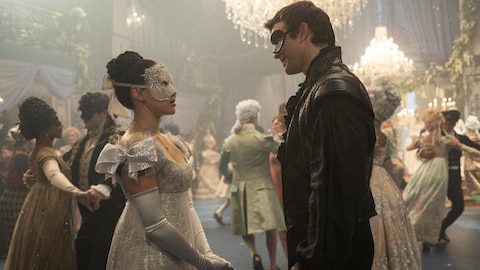
Bridgerton's new season dropped, and I think it broke something open in a lot of us, in the way only truly unhinged romantic television can. All of us, collectively losing our minds over a glance that lasted two seconds too long, over a hand that almost touched another hand, over a restraint so loaded it felt more intimate than anything explicit. And I kept thinking: we have been so starved for this. For this specific experience of wanting something you cannot have yet, of desire that has nowhere to go and just keeps building. Because if you look at where we actually are with the way people date in this generation, the emotional vocabulary we have all agreed to use is basically just multiple variations of “I don’t care too much.” There are situationships, never-ending talking stages, exclusively seeing each other but not committing, the whole exhausting performance of being the person who cares less.
The thing is, once you start looking, the same hunger turns up absolutely everywhere. In the obsessive fandom around Heated Rivalry, the surprising emotional charge of The Bride, and then, perhaps the strangest and most unhinged example of all, Wuthering Heights, a book Emily Brontë published in 1847 that is currently experiencing what can only be described as a completely unearned internet renaissance. People who are chronically online are sobbing over Heathcliff and posting video essays about Catherine as if she were a childhood friend who made some questionable decisions they cannot stop thinking about. People are reading it for the first time and reacting like it was written specifically about their situationship with a guy who never texted back. And the funny thing is, it kind of was, just a hundred and seventy years ago, for a different girl who also had too much feeling and absolutely nowhere to put it.
The slow burn is back, and the culture has clearly decided it has been unbothered long enough.
What we're actually hungry for
Which brings us to the most uncomfortable question underneath all of this: if we have access to more people, more options, and more connections than any generation before us, why does so much of modern dating still feel like emotional malnourishment?
The slow burn as a genre reveals something about what we have collectively agreed to give up. The glances, the restraint, the unbearable tension of two people who want each other and do not say it, none of that is actually about romance being old-fashioned. It is about desire being taken seriously. Two people mattering enough to each other that the waiting itself becomes a whole language. And somewhere between the talking stages, the roster management, and the performance of unbothered-ness, we seem to have lost fluency in exactly that.
Chaani Srivastava, a tech lawyer and writer based in Mumbai, has been thinking about this longer than most, and from an angle that is equal parts romantic and surprisingly legal. For her, the slow burn is a counterargument. She describes the anticipation at the heart of these stories as something almost physiological, the kind of feeling that is harder to access the more connected we become. "It stirs something primal," she says. "It feels like coming up for fresh air after being underwater. Romance as a concept thrives in the not-knowing, the gaps imagination fills with fantasies of the unknown other. Without that distancing, there's no buildup, no hope elongating the pleasure. And it is that anticipation that makes it so satisfying to watch, because it keeps the hope alive." I think about this a lot, especially how the not-knowing used to be the whole point, how the story you told yourself about a person was its own kind of intimacy. As someone who works at the intersection of technology and human behaviour, Chaani sees what apps and constant communication have quietly dismantled, and she does not mince words about it. "As a tech lawyer, it also feels a tad bit sad, as this is a place where technology's encroachment has resulted in killing the mystery," she says. "It is akin to killing an entire emotion available to be felt by humans. Our aim is not to become those machines that control us."
And yet here we are, collectively losing our minds over fictional people doing nothing more than standing too close to each other in a ballroom. Chaani thinks that is exactly the point. What we are responding to, she argues, is less sentimentality and more a kind of instruction we have been craving. "Those stories show the potential of imagination of a human mind — not machines — and its ability to not get so easily bored in modern-day dating patterns faster than ever," she says. "They are lessons in patience, perseverance and a sort of understanding of one's own willingness to wait for the other person to reveal themselves — all of which are the exact opposite of anything quick." Which, when you think about it, says everything. "The fact that these stories are seeing a surge in their popularity is owing to the fact that they are satisfying something that we are missing collectively," she says. "They are filling some gap with their storyline, which is enabling us to live that emotion, absent in our real lives, vicariously." We are watching slow burns because something in us still remembers what it felt like to want something and just — sit with it. And that feeling, it turns out, is harder to shake than we thought.
Men are down bad, and we love it
Yearning has always had a gender assigned to it. Women were the ones who waited, who felt too much, who loved people with a dedication that would exhaust anyone with functioning self-preservation instincts. On the other hand, men were constantly told to pursue, act, and move things forward. That was the deal. Which is partly why female yearning became such a recognisable thing in the first place; the wanting was always supposed to be one-sided, and it was always supposed to be hers. She yearns, he decides. She waits; he eventually shows up, hopefully with some kind of revelation. Very efficient distribution of emotional labour, really.
What shows like Bridgerton has done, and what I think is making people absolutely unwell in a way they cannot fully explain, is put the yearning on both sides of the room. The men are suffering too. They are standing in ballrooms, looking at people they cannot have, with an expression that can only be described as a five-act internal tragedy unfolding behind their eyes. That quality, the holding back, the visible effort of a man trying to seem composed when he is clearly falling apart at a molecular level, was always considered a feminine thing to feel. And now it is being handed to male characters as their whole personality, and people are losing their minds over it. Heathcliff, unhinged disaster that he is, is basically just yearning with a coat on. The men in Heated Rivalry are just as emotionally consumed as the women. Nobody is okay, and the best part for other yearners is that everyone is suffering equally. It is, genuinely, a great time.
And that equal suffering is doing something kind of interesting. When the wanting is mutual and visible, women are no longer the only ones carrying the mortifying weight of caring too much. There is something genuinely relieving about watching a man be completely undone by someone. Standing in a room, holding himself together with what can only be described as a prayer, while the person who has absolutely ruined him is just standing there, probably also ruined, pretending to look at a painting. Both of them were equally at the mercy of something that showed up uninvited and refused to leave. Which is, honestly, the only kind of love story worth losing sleep over.
Lead Image: IMDb
Also Read: Is it sexual tension? Here are 10 signs you can’t miss
Also Read: How dating apps are fuelling the rise of roster dating