

What 'Bridget Jones’s Diary' taught me about life
Before the film came the book, and both taught me how to find humour in heartbreak. Thirty years since the latter released, I revisit its learnings on life and literature.

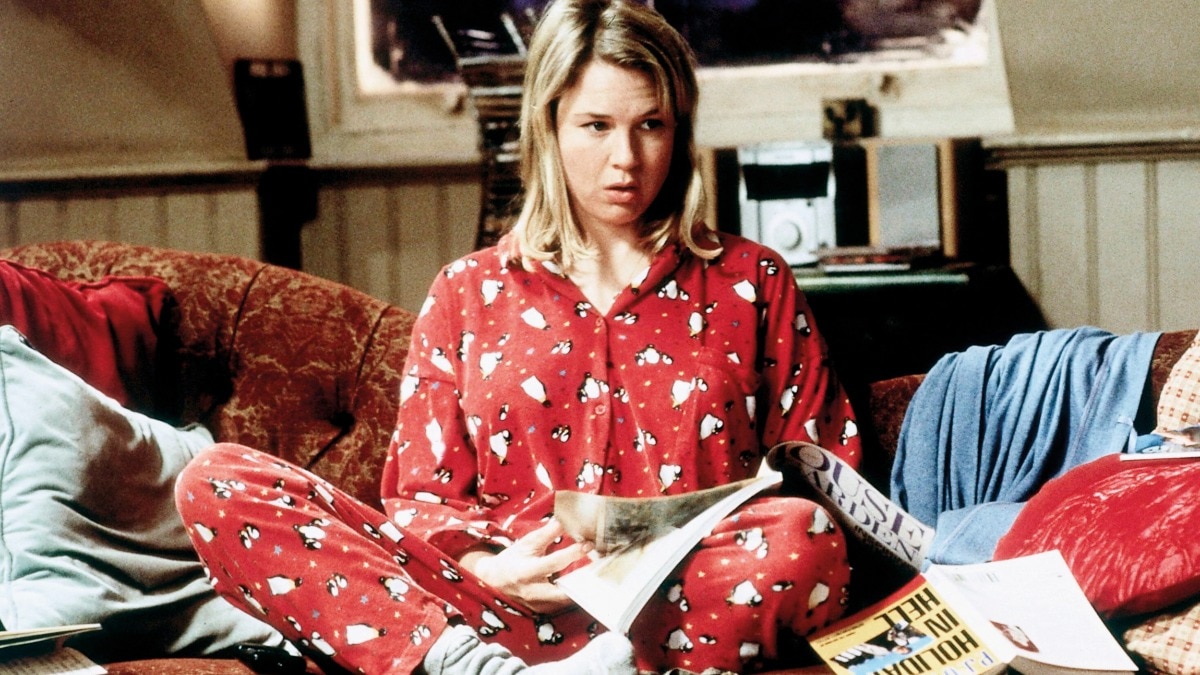
The fact that I was seven when Helen Fielding published Bridget Jones’s Diary in 1996 (and the fact that you now know my age) continues to unsettle me. I discovered the book years after it had hit the shelf, in a nondescript corner of my school library. By then, the films had made actor Renée Zellweger (who plays the titular character) the narrator in my head—complete with a sharp British accent.
Imagine a teenager struggling with weight issues in an educational institution that thrived on building marksheets over morales, and an imagination so active that daydreaming was their favourite sport. That was me, and Bridget fit right in—perfectly awkward, deliriously and mostly unintentionally funny, far from the size zero obsession of the early 2000s, and with hope and wit mingling in a love triangle that she manifested decades before Instagram juiced the word.
Fielding created a universe that played with ideas of insecurities, friendship, womanhood, and the workplace with such nonchalance that there were always feelings to feel. “Sunday January 1—Food consumed today: 2 pkts Emmenthal cheese slices, 14 cold new potatoes, 2 Bloody Marys (count as food as contain Worcester sauce and tomatoes)”—reads an entry in the book, which is written like a daily diary.
While the humour made it my backpack companion, it was how Bridget opened up to her own self that hit a deeper note. She gave life to my early understanding of inner talk—a voice that dithers and doubts, sometimes changes tracks mid-thought, and the sheer amusement and hilarity of it all. No passage captured this better than Bridget’s pre-date, 6 pm spiral—among my favourites.
“Being a woman is worse than being a farmer. There is so much harvesting and crop spraying to be done: Legs to be waxed, underarms shaved, eyebrows plucked, feet pumiced, skin exfoliated and moisturised, spots cleansed, roots dyed, eyelashes tinted, nails filed, cellulite massaged, stomach muscles exercised. The whole performance is so highly tuned you only need to neglect it for a few days for the whole thing to go to seed.
Sometimes I wonder what I would be like if left to revert to nature—with a full beard and handlebar moustache on each shin, Denis Healey eyebrows, face a graveyard of dead skin cells, spots erupting, long curly fingernails like Struwwelpeter, blind as a bat and stupid runt of species as no contact lenses, flabby body flobbering around. Ugh, ugh. Is it any wonder girls have no confidence?” Three decades since the book released, and it’s still a hard relate.

All by myself
Fielding took Jane Austen’s 19th-century classic, Pride and Prejudice, and brought it into Bridget Jones’s Diary in ways that were part ironic, part goofy, and part an ode to the women who have shaped literature across history. While she lived, Austen’s work was published anonymously—her “By a Lady” signature a reflection of the society and its quiet norms at the time.
Fielding’s story engaged with Austen’s popular tropes in diverse ways. For instance, Bridget’s two love contenders included the sexy, obnoxious boss Daniel Cleaver (portrayed by Hugh Grant in the film), and the stand-offish, uber-serious Mark Darcy. The latter a direct ode to Austen’s Darcy, with British actor Colin Firth famously playing the character in both the 1995 British TV adaptation and the Bridget Jones’s Diary franchise.
“It is a truth universally acknowledged that when one part of your life starts going okay, another falls spectacularly to pieces,” Bridget says in the film, also alluding to one of the most famous opening lines in the history of literature, written by Austen for her seminal work: “It is a truth universally acknowledged that a single man in possession of a good fortune must be in want of a wife.” Not only romance—as the familial dynamics unfold in Bridget’s world, the story delves into multiple layers of relationships. Like ageing parents facing a late-life crisis, friends that treat you as a mirror to their lives, and families that judge, pity, and perform. Sometimes, all at once.

Scripting from the heart
Fielding’s work is often boxed into the chick-lit genre—the sort of thing self-proclaimed literary purists would consider a banal read. For me, Bridget Jones’s Diary is a millennial-age literary great. Apart from notes on love, loss, and figuring how to laugh in the most tumultuous situations, it taught me how to write, to be ‘light’ with words, and most importantly, authentic.
Being Bridget is being funny and unapologetic about your quirks and idiosyncrasies. To be in touch with your feelings, and even packaging heartbreak with humour. Because that’s perhaps the biggest lesson of all—to feel everything fully without taking life too seriously. As the internet has already declared: It’s not like we are getting out of it alive, anyway.
This article originally appeared in Cosmopolitan India May-June 2026 print issue.
Images: IMDb
Also read: Can egg freezing buy you more time? Here's why women are embracing the procedure
Also read: The new movies and TV shows everyone will be talking about this month
Comment
more from Life

Unique gifts for every personality: Meet them where they are
#SaneGirlEra: Six research-backed apps to help you cope with anxiety

Festive shopping on your mind? Amazon Great Indian Festival 2026 brings Pooja essentials and Diwali gifting at up to 60 per cent off
Are you too independent to be loved?
We know what a healthy relationship looks like, so why do we keep making excuses for the unhealthy ones?

Meet anti-blush, stained glass lips, and 4 other trending makeup looks for fall

Beyond the metros: Smaller cities drive over half of Amazon’s festive fashion and beauty orders
Is the fear of falling first ruining modern dating?
Everyone wants a “low-maintenance relationship” until they’re actually in one
I deleted Instagram for two months and forgot what was wrong with my face